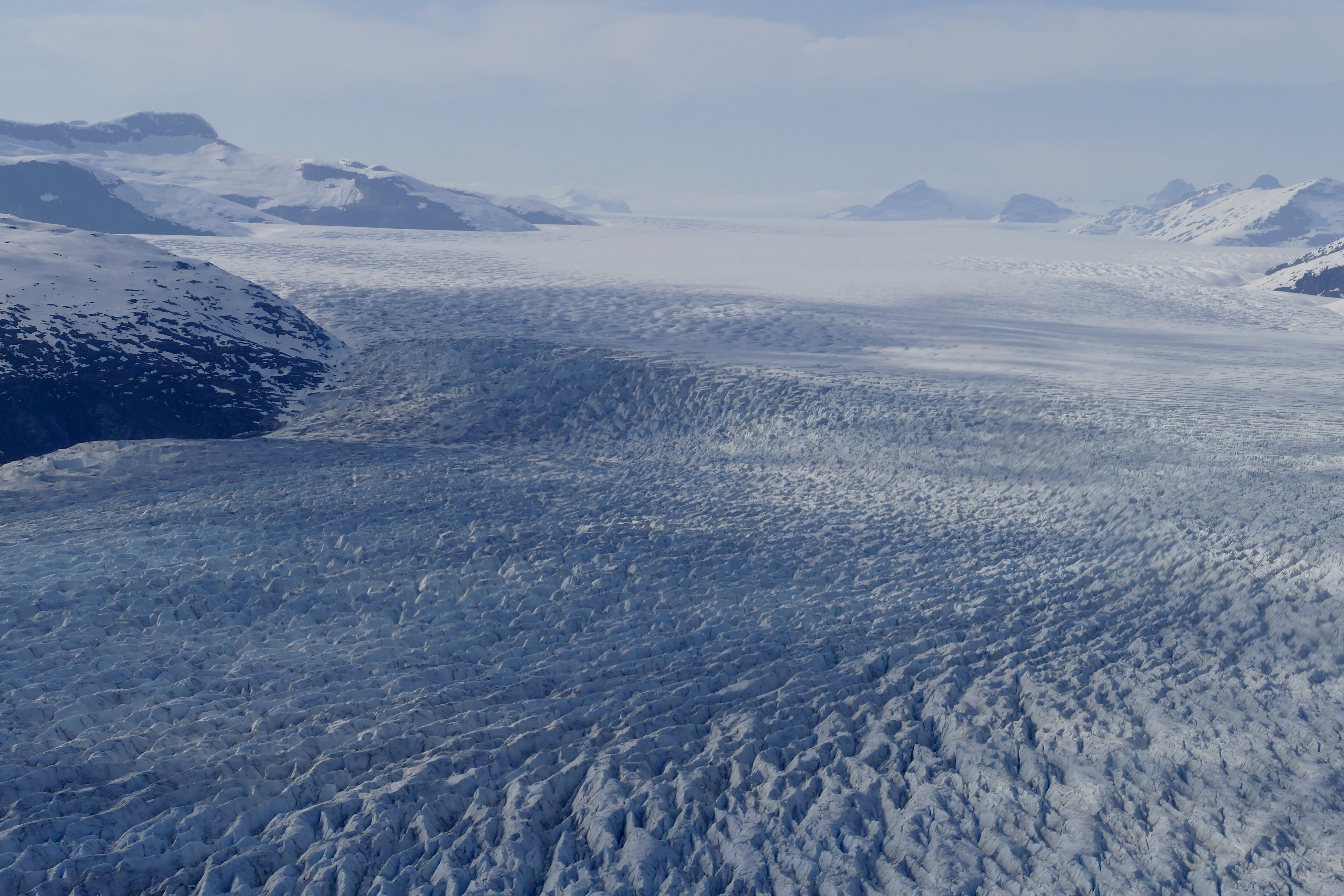
The immediately preceding post showed a small part of one of the same glacier’s obviously-retreating edges.
Not very many seconds earlier, we were looking down – and upstream – at an unknown number of square kilometres of this still-gigantic “river” of ice’s surface.
Alaska has nearly 20,000 named glaciers.
It is one of the world’s most glacier-rich states/nations/territories.
Collectively, Alaska’s glaciers are the world’s most rapidly-depleting/retreating, even disappearing.
Not coincidentally, the warming-climate trend is particularly pronounced/dramatic in Alaska.
The potential (mostly “negative”, but some “positive”) consequences are enormous, not fully understood, certainly not entirely predictable, and are – variously – much-debated, intensively studied, and wilfully ignored.
They range from potential devastation of one of the world’s richer fishing grounds, whilst perhaps simultaneously opening up new opportunities for salmon, to an increase in BOTH floods and droughts and BOTH fire and rain, and likely-enormous changes to where Alaska-bound tourists will wish to go…and to where it will even be possible for them to reach.
Click here for one overview.
One paragraph:
Rising temperatures and changes to precipitation are causing glaciers in Alaska to melt at some of the fastest rates on Earth. In Southeast Alaska, total glacial volume is expected to decrease by 26% to 36% by the end of the 21st century. Glaciers act as reservoirs, storing snow and ice in the winter that melt and replenish waterways throughout the warm season. As glaciers retreat, their contribution to streamflow will decrease. These changes can disrupt the natural cycle that sustains entire ecosystems, both on land and in the ocean.
Comments