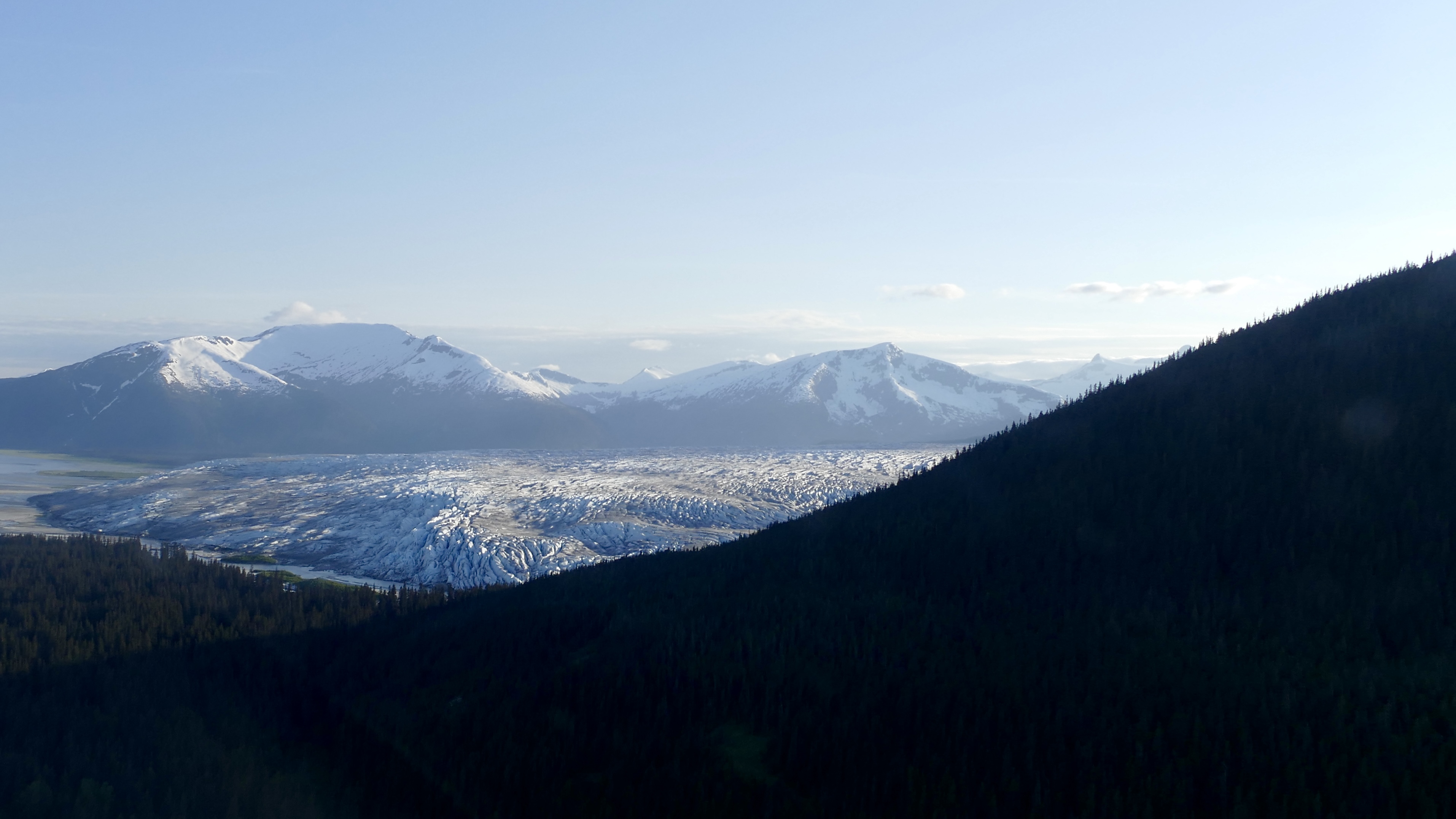
The headline refers to area, not population – nobody makes their home atop the Taku Glacier’s surface, which still covers 650-plus square kilometres.
i took this post’s photo at 7.39 pm on 24 April 2015, circa one minute after “our” floatplane lifted off the Taku River, adjacent to Taku Lodge, and we began the return flight to Juneau.
In less than one more minute – as you will see in the next post – we’d be immediately in front of the Taku Glacier’s enormous snout.
This is the world’s thickest mountain glacier, but….
Taku Glacier’s maximum ice-depth was generally reckoned at only a little less than 1.5 kilometres!
Its snout (terminal face) was circa 9 kilometres wide.
Through most of the second half of the 20th century, as almost all of Alaska’s other glaciers were “thinning” (losing ice mass) and receding, the Taku was the one big “tidewater” glacier which not only still qualified as a “tidewater” glacier, but was actually continuing to advance.
Since the late19th century, the Taku Glacier had advanced more than 7 kilometres and reached a total length of about 58 kilometres.
By the 1990s the Taku was no longer advancing, but initially appeared to be “holding its ground”.
Come 2019 – as widely reported, worldwide – it had become readily apparent that the Taku had “joined the club”.
For at least the foreseeable future, it had become yet another dramatically-thinning, rapidly-receding glacier.
Click here for a vivid and succinct 2019 account and explanation.
Comments