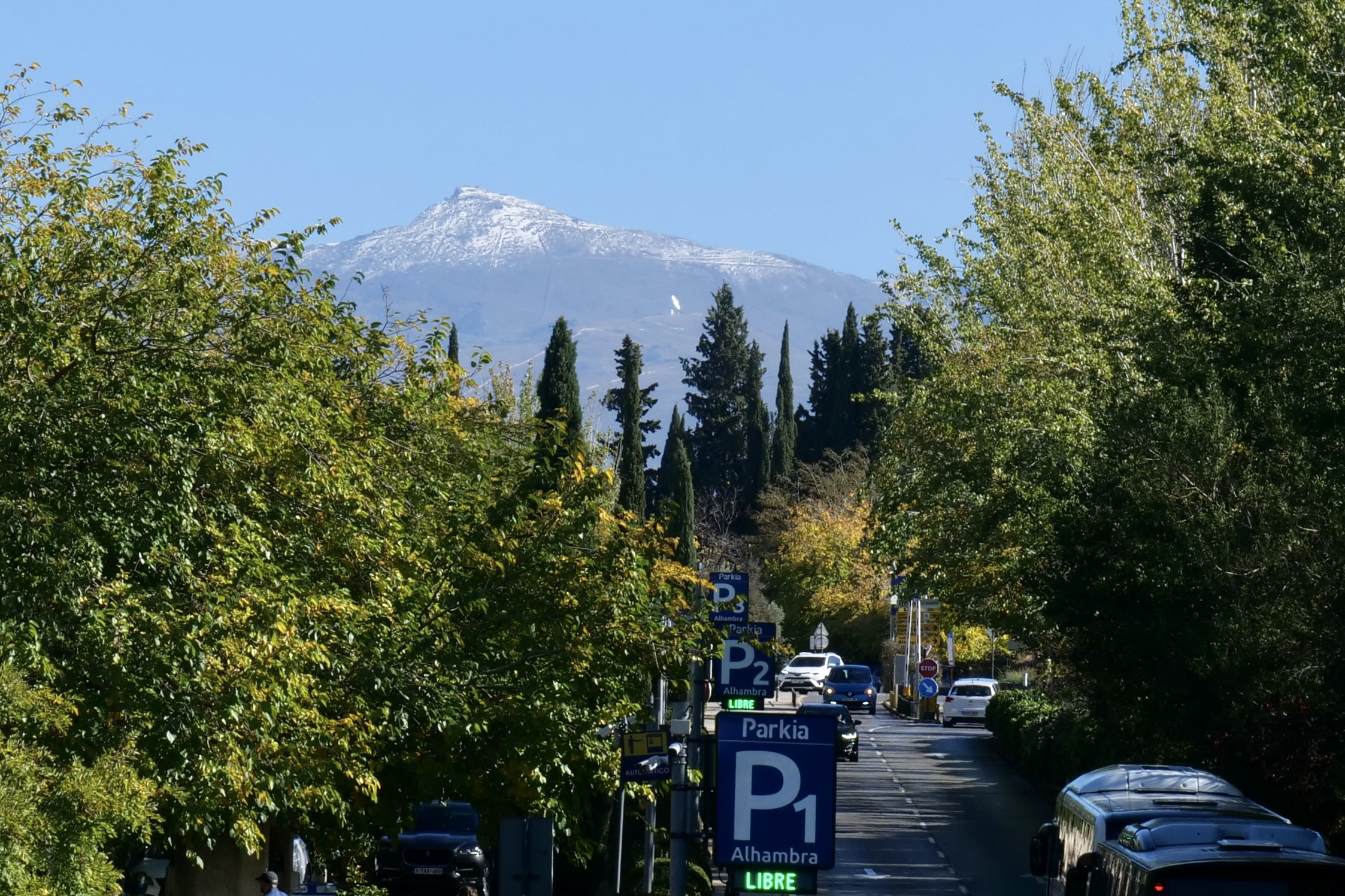
I took the photo in Granada, Andalucia, on the afternoon of 03 November 2025.
My vantage point was near the “main gate” to Spain’s #1 tourist attraction.
The urban ground on which I stood was probably just a little higher than is the highest point in “The Adelaide Hills”; Mt Lofty Summit is 710 metres above sea level.
As a child, I regarded Mt Lofty as a “mountain”; for my first seven years it was the loftiest peak I had ever seen…or reached.
Pictured with a recent “dusting” of autumn snow, the high point in this post’s photo is Veleta.
Veleta’s summit is a very few metres shy of 3,400 metres; it is the Sierra Nevada’s second highest peak, and the entire Iberian Peninsula’s third highest point.
Spain is a much “higher” nation than most Australians imagine!
Australia, Morocco and Spain are all relatively dry, hot nations.
All three, however, have alpine zones, ski resorts, and winter-cool places on which a lot of rain falls and where tall forests grow.
Australia’s is the lowest continent in terms of its average elevation (330 metres ASL) and the modest (2,228 metres) altitude of its highest peak.
If you look carefully at the slopes below Veleta’s summit you will notice a radio telescope’s “dish”; Europe’s highest – at 2,920 metres – IRAM’s is one of the world’s most sensitive such “dishes”,
In average elevation – 660 metres ASL – Spain stands twice as tall as Australia.
Morocco stands taller again, with an average elevation of 909 metres; the highest peak in its Atlas Mountains reaches 4, 167 metres – almost twice as high as Mt Kosciusko.