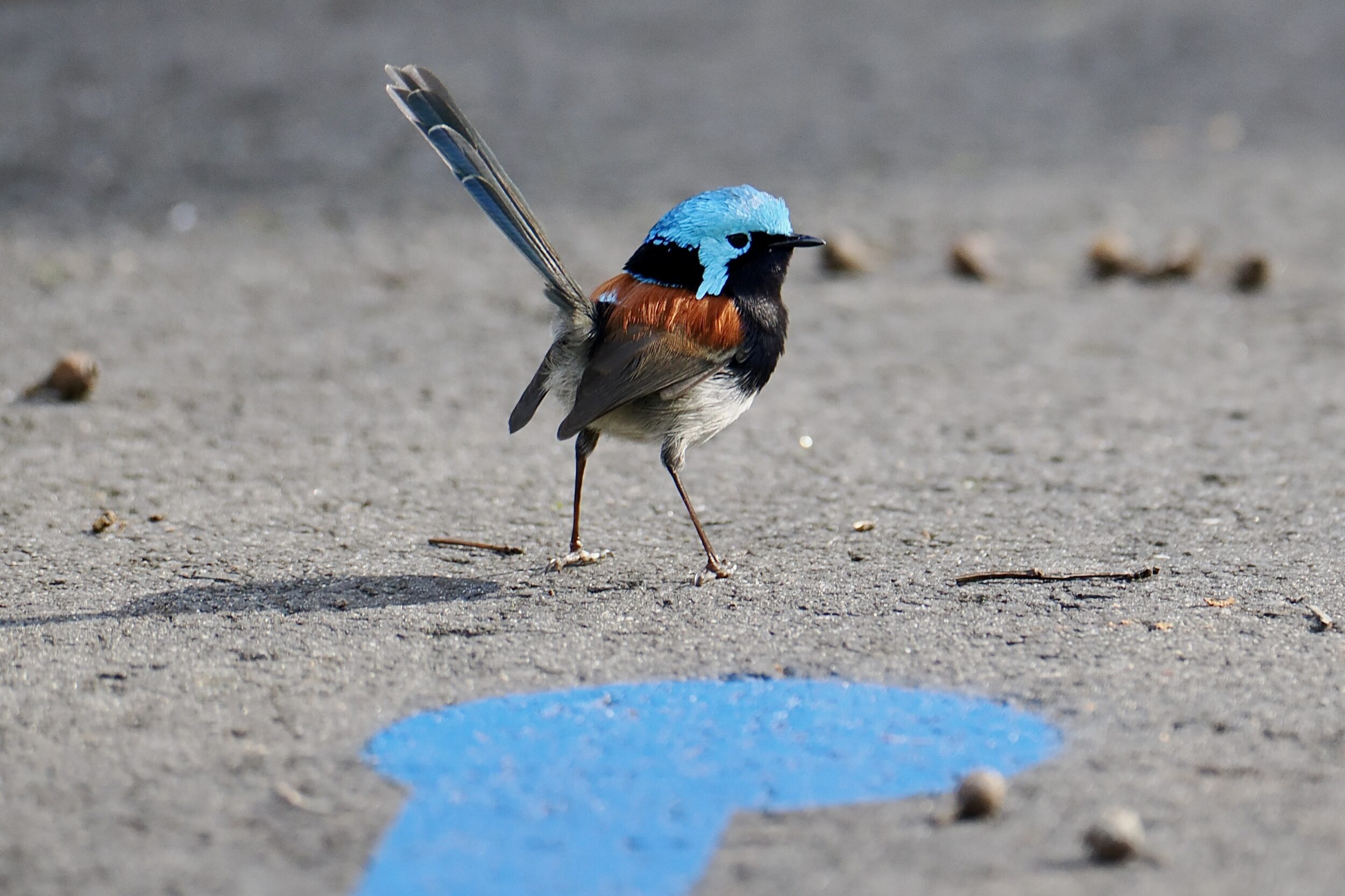
The featured image (above) was taken at 2.51 pm on 18 August 2025, near Beedelup Falls, in southwestern Western Australia’s “Karri country”.
Although not a very fine photo, it does show some very unusual behaviour.
”Flaunting it” is something to which any male member of the genus Malurus – the eleven Australian species generally known as “fairywrens” – devotes a deal of his life.
Generally, however, these “show-offs” are very wary; as soon as a flaunting fairywren senses a human’s presence, he “disappears”.
Q: So why was the pictured individual right out in the open, on a sealed roadway’s surface, and utterly unalarmed by my very obvious, very close presence?
A: Allow me to speculate; I do not entirely know the answers…
Conveniently close to Pemberton, Beedelup Falls is a very popular tourist attraction, especially during winter and spring.
A sealed road loops into and out of a generous number of parking spaces, information bay, shelter, trailheads, et al.
The local fairywrens have become accustomed to the frequent comings and goings of humans.
The birds have learned that these humans have no predatory intent.
Still, even when wrens have become accustomed to humans, the flaunting or foraging birds usually prefer to have some “cover”, very close-by.
(I was raised on a farm. The wrens on our lawn would not necessarily “disappear” the moment they sensed resident humans’ proximity, but they rarely moved more than a metre or two distant from the nearest bushy undergrowth)
Here, however, two male red-winged fairy wrens ventured right out into the middle of a large, sealed road/path/apron; they were inescapably aware of my presence, but felt no need to “disappear”.
Then, “the penny” dropped; in this particular circumstance, humans’ presence was fortuitously providing “protection”.
All small Australian birds are acutely aware of their status as “prey”; they are “on the menu” of a whole lot of predatory birds, plus the occasional rodent & marsupial…and of millions of cats.
Almost all of those predators vamoose whenever humans become conspicuously present.
So, feeding and flaunting, right out in the open – normally, dangerous/foolhardy activities for a fairywren – can become uncommonly safe, once tourists and hikers turn up!
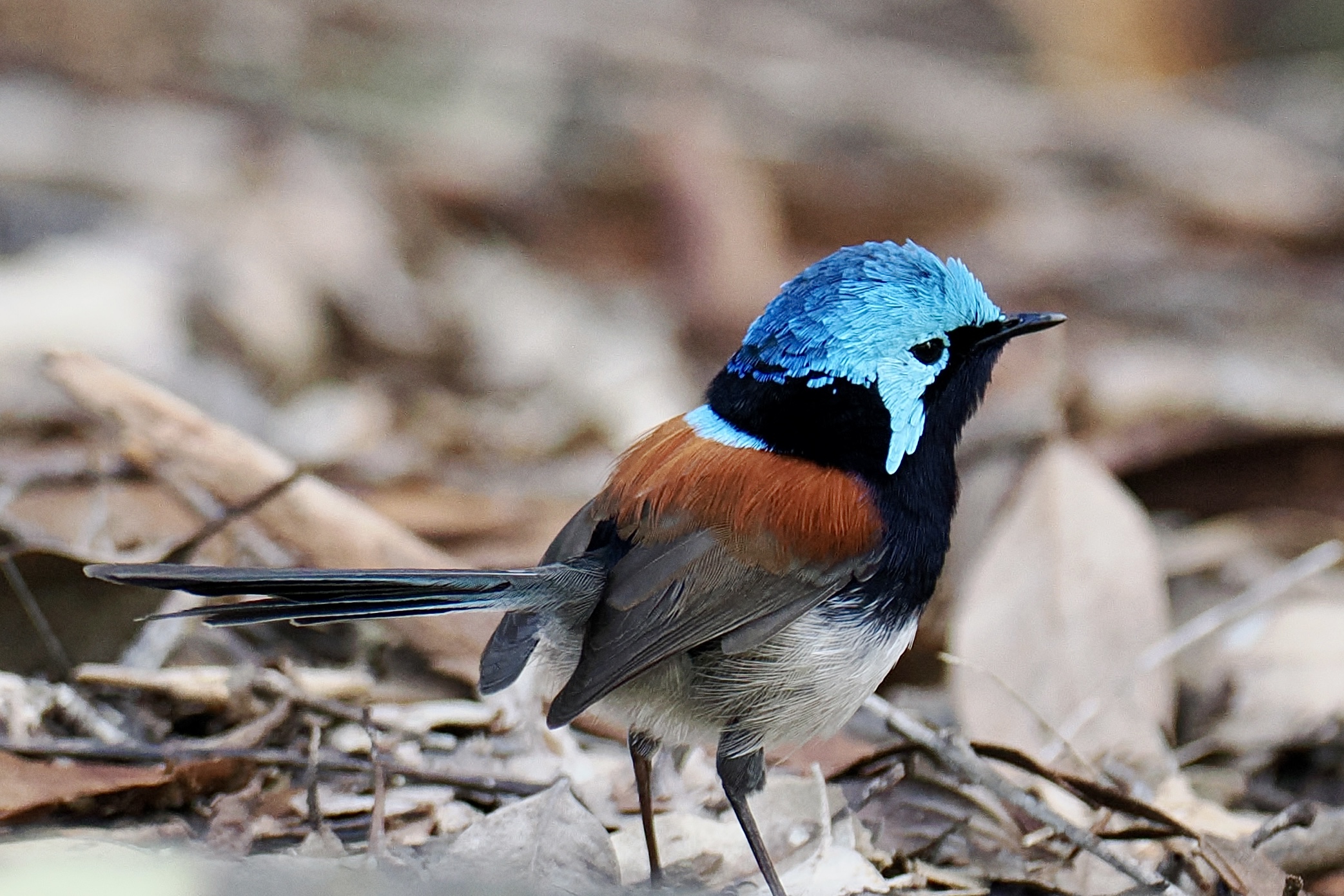
Red-winged fairy wrens occur only in wetter parts of southwestern Western Australia.
Click here for other posts which feature them, and for more information about the largest (but still tiny) and longest-lived of Australia’s fairywrens.