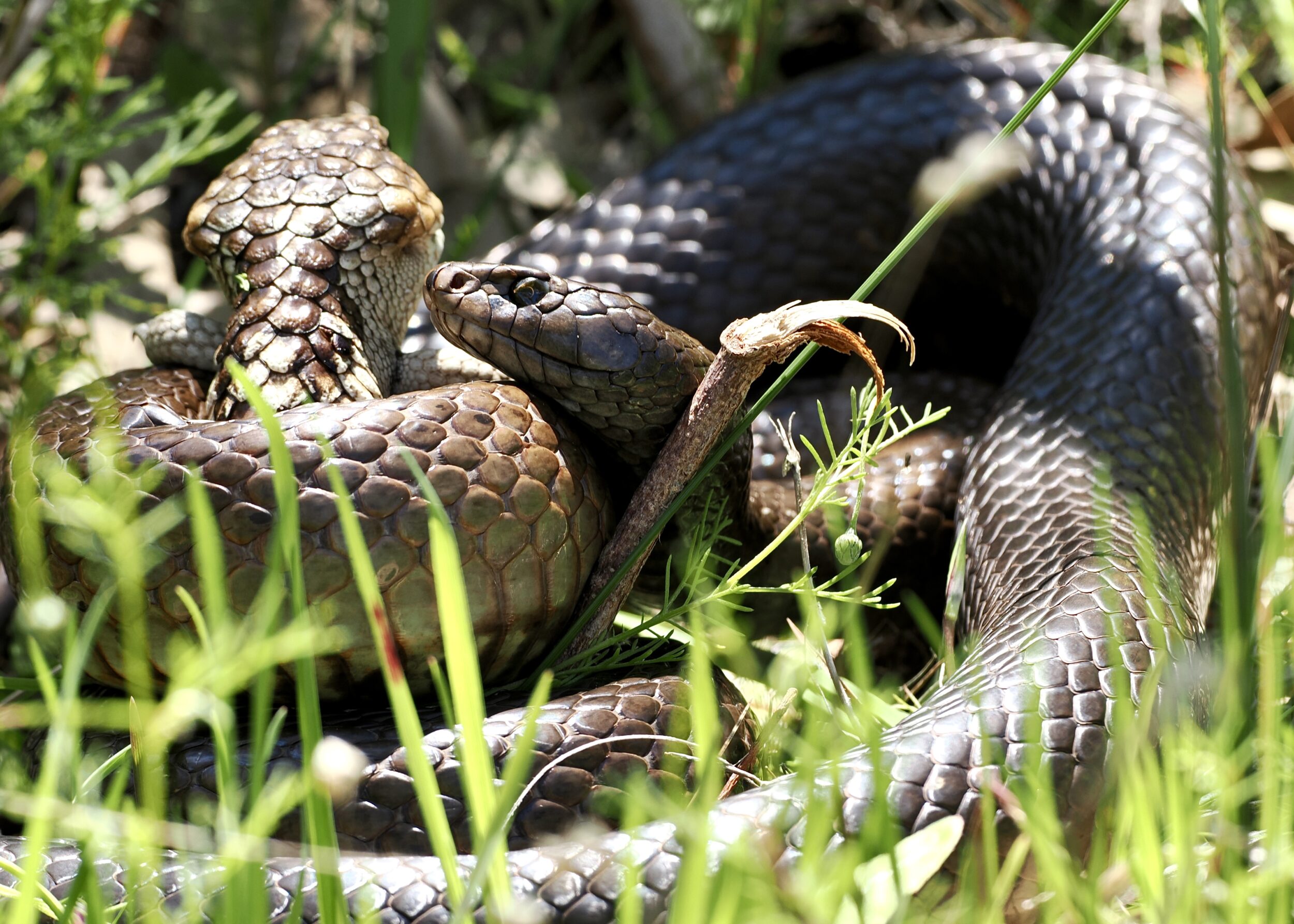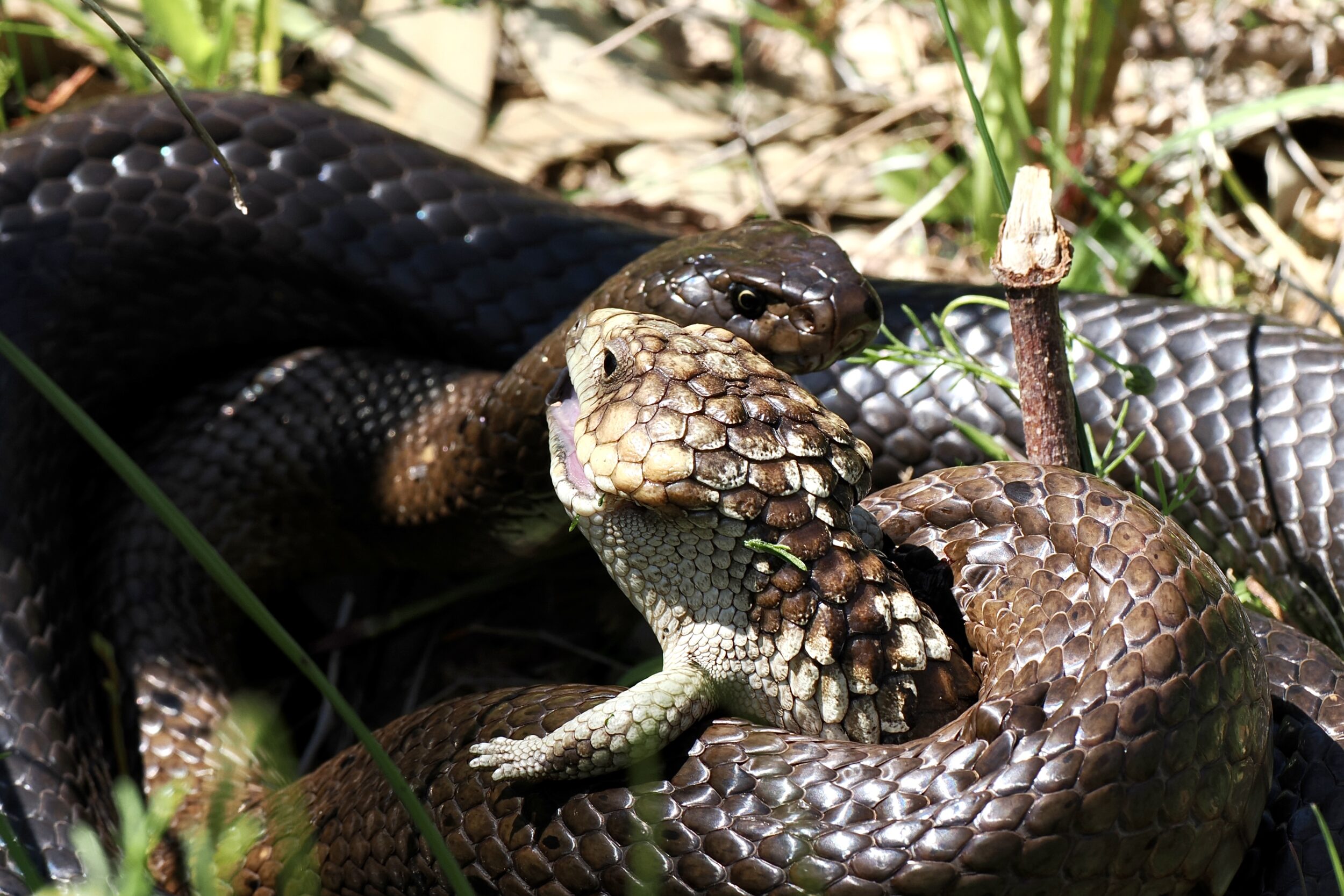
The Dugite is a highly venomous brown snake.
Pseudonaja affinis does very well in 21st century Perth, where house mice (“kindly”/accidentally introduced by European colonists) have become the species’ preferred prey.
Dugites, however do still target “traditional” prey: lizards, rodents and other snakes, including fellow dugites.
On 20 September 2025 a close encounter of the “dugite v bobtail” kind provided the most dramatic experience of our 42 years as frequent visitors to Kings Park.
We were in “wildflower” mode, and had not expected a “safari” experience!
I took this post’s featured image less than half a minute after the previous one’s.
A minute or two earlier, we had been strolling along a bush track, heading in the general direction of Subiaco…and lunch.
We noticed that, just a few metres down a side-track, four people were looking very intently at something going on in the bush…something very close-by.
They beckoned to us.
We could scarcely believe our eyes!
A suitably large dugite had captured a blue-tongued skink – specifically, a young bobtail, Tiliqua rugosa.
Bobtails have many “common” names, including “shingleback”, “blue tongue”,and “sleepy lizard”… with “skink”, “lizard” or “goanna” variously added.
Yesterday’s post featured the first photo I took; this and the next post’s photos are sequenced chronologically.

The young bobtail had already been contained//constricted before we arrived, so I assume that #12’s photo captured the snake re-envenomating the lizard – giving it a lethal “repeat dose”.
Dugite’s venom’s potency is generally rated as one of snakedom’s “top 20”; Australian species occupy all of the alleged “top 10” places in this particular “global elite”.
However, the venom is relatively “slow”; it does not instantly disable its target, let alone instantly kill it.
The pictured, “python-like” behaviour – constricting/restraining the intended victim – is a strategy commonly deployed by venomous Australia snakes.
A freshly-injected lizard could otherwise escape its envenomator’s grasp!