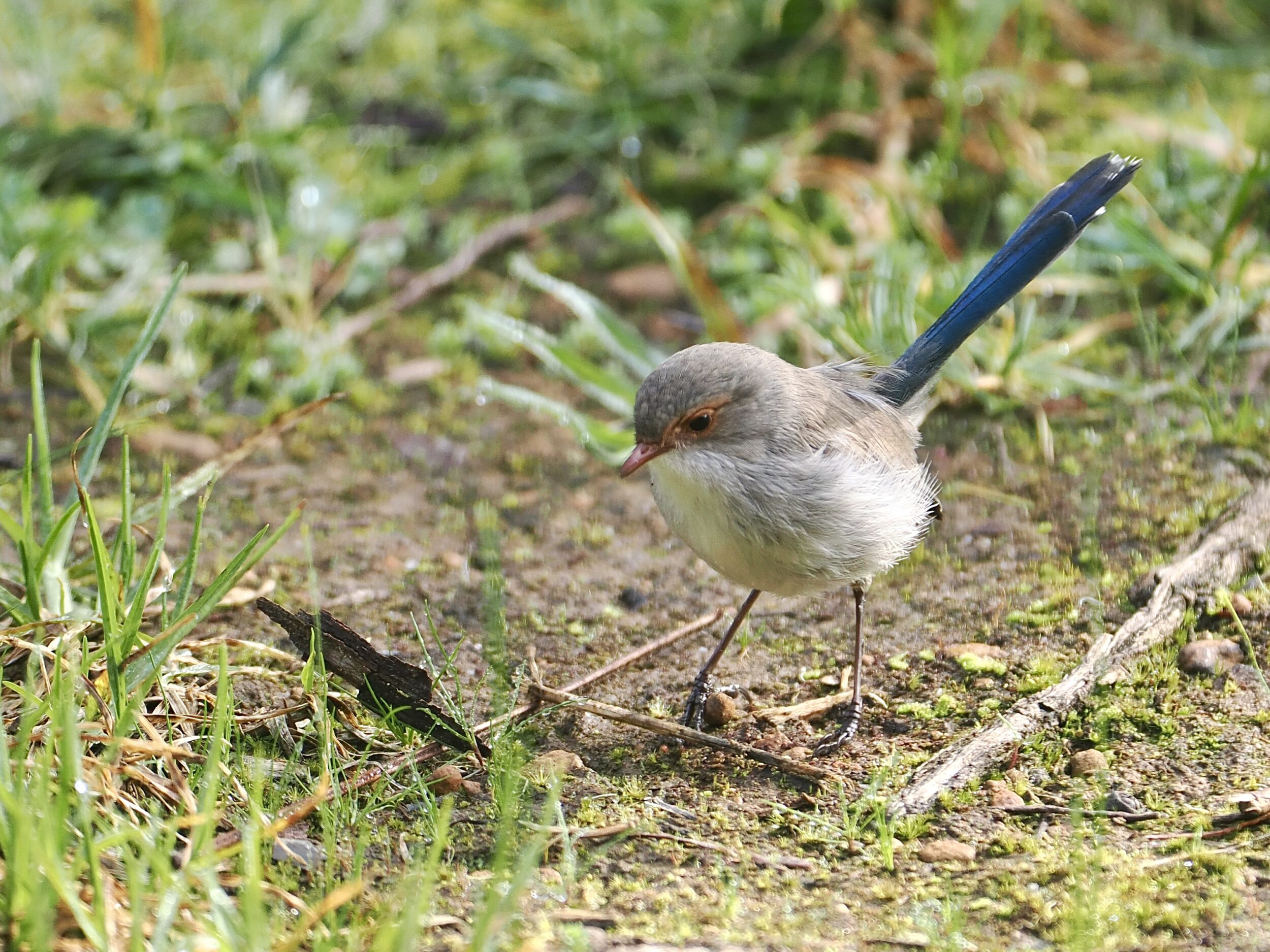
At 9.11 am on 17 August 2025 the pictured individual was very close to us.
She was just on the other side of the living room window.
All of us were enjoying the morning sun, after a very rainy night in and around Pemberton.
The particular location is one where we really like to stay…and which fairywrens (and many other petite birds) also like.
(the relevant cottages are less than a five minute drive from Pemberton. They share their name with the adjacent forest, and are blessed with generous, nature-loving owners)
The hero/ine of #11 in this series – photographed the previous afternoon, less than 100 metres away – was definitely a white-browned scrubwren,
This post’s heroine is definitely a female fairywren, but her beak makes me unsure of her species.
I am almost certain that all male fairywrens we saw that morning were Malurus elegans – the red-winged fairywren.
This very beautiful species lives only in well-wooded parts of WA’s southwest.
(discover & see more here)
Both male and female red-winged fairywrens are meant to have black beaks.
So, this post’s heroine “should be” Malurus splendens – the splendid fairywren; this species’ males have black/ish beaks, but females do not.
When a WA-resident human says “blue wren”, s/he is almost certainly referring to Malurus splendens.
S/he – on home turf, at least – would not have in mind Malurus cyaneus – the superb fairywren, which lives only in southeastern Australia.
Aesthetically, Australia’s two best-loved “blue wren” species are equally splendid/superb.
(Malurus splendens is most abundantly-present in southwest WA, but does reach the “far” side of the Nullarbor, albeit only in places well west of the inland side of the Great Dividing Range)