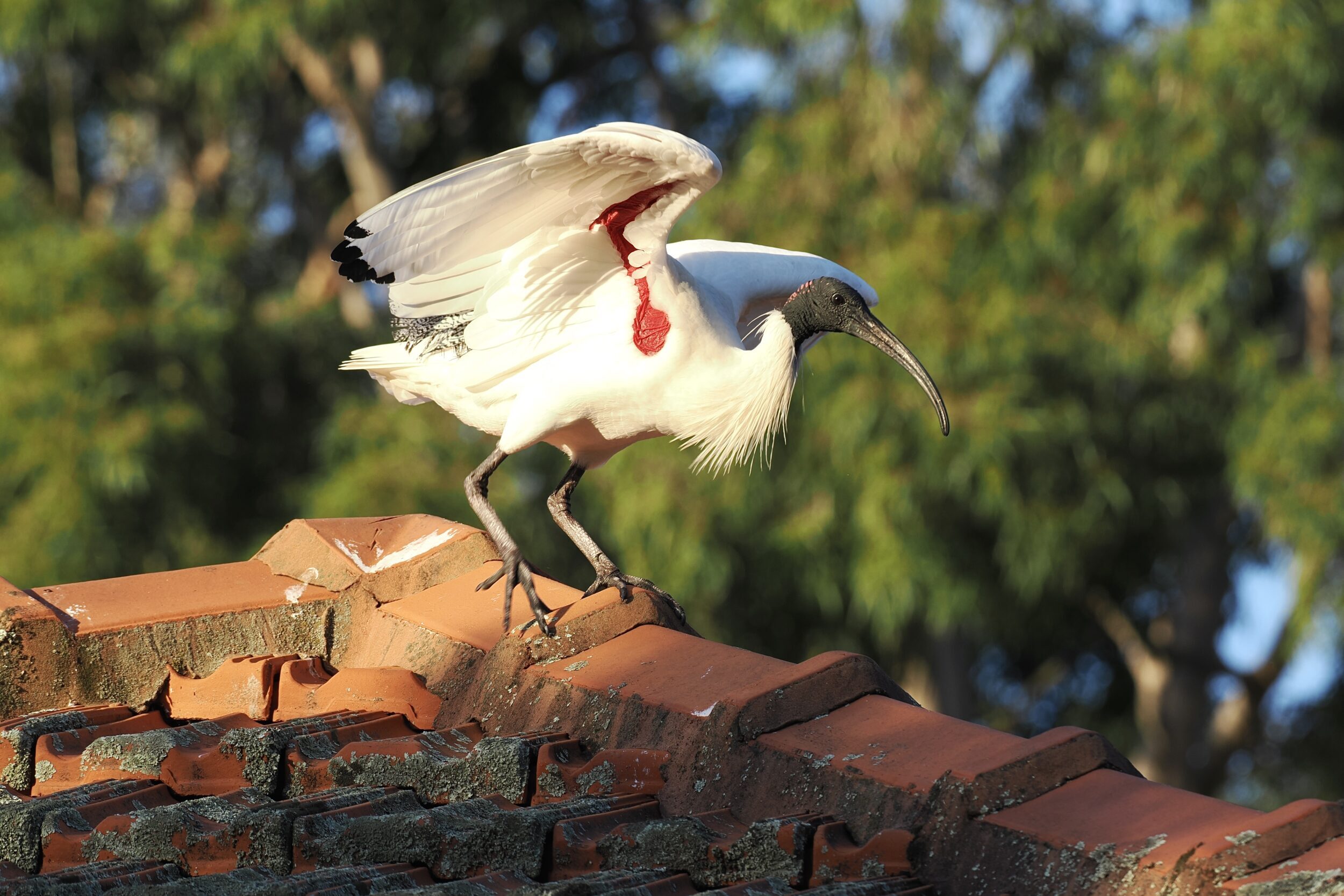
Urban-resident Australian humans who were born after 1970 may find it very hard to believe, but this post’s headline is accurate.
Relatively speaking, Threskiornis molucca – the Australian white ibis – is a newcomer to urban life.
However, the so-called “bin chicken” was already resident on the Australian continent long before Homo sapiens arrived – let alone post-1788 humans and rubbish bins.
It is absolutely not a “feral” bird.
Contrary to what many Australians believe, it and the so-called “Sacred” or “Egyptian” ibis are entirely different species; the latter has never called Australia home.
Still, the roof of a “Federation Era” house in any Australian city – such as the Subiaco one, above – almost certainly never felt the pitter-patter of Threskiornis molucca‘s not-so-tiny feet until the final quarter of the 20th century, or the first quarter of the 21st.
It is generally reckoned that the “bin chickens’ move into the big smoke” only began in the late 1970s, after a severe drought had rendered “unliveable” their “traditional” breeding and feeding places.
The species has been able to colonise urban areas by reducing its fear response when in close proximity to humans, and by significantly widening its suite of food items to include human refuse – strategies that other closely related species such as the straw-necked ibis and the spoonbills have not replicated.
The italicised recipe for urban success is from the species’ pleasingly substantial Wikipedia entry.
“Bin chickens” have now made themselves at home in all mainland capitals; their arrival in Launceston and Hobart is likely to occur within the lifetime of most current residents.
I photographed the pictured individual at 4.36 pm on 26 June; the bare-skinned “GT stripes” are a “standard feature”; during breeding season they are “upgraded” from dull pink to brilliant red.
All remaining chapters in this little series involve non-urban and wetter places, hundreds of kilometres south of Perth.