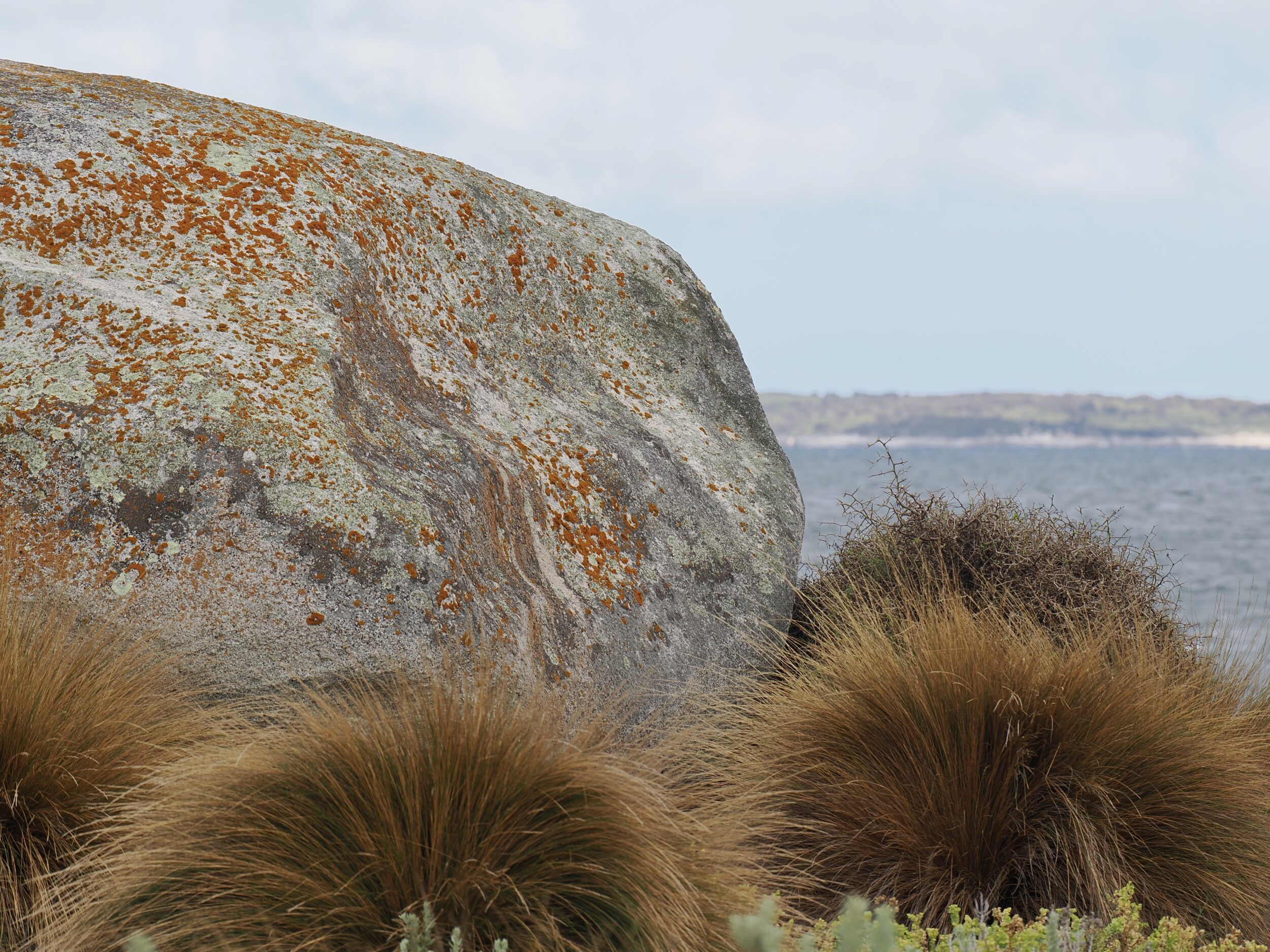
As highlighted in this series, Flnders Island’s shorelines are both beautiful and very demanding – especially for plants.
I imagine that not a few visitors perceive a place such as the one pictured above as “unspoilt”, “wild”, “pristine”.
The above adjectives are “wildly” inaccurate!
(I took the photo on the southern half of Flinders Island’s west coast at 10.08 am on March 2025. I love such places, where things “hard” and “soft”, “massive” and “petite”, “inanimate” and “living” all coexist, near terra firma’s edge)
The pictured thorny plant is a boxthorn (probably an African boxthorn) – one of more than a few highly invasive pest plant species on Flinders Island.
I am not a botanist.
I fondly hope that the photo’s beautiful tussocky grasses are “locals”; but fear that they might be invasive aliens.
I am nigh certain that a deal of the green at the bottom of the image is sea spurge; Euphorbia paralias poses a major threat to Tasmanian coastal ecosystems, as explained and illustrated here.
The rock’s many lichens are not problematic; their benign abundance is indicative of how truly “fresh” and unpolluted is Flinders Island’s air.
Musical bonus
A little more than half a century ago another splendid coastal location (in another hemisphere) inspired Canadian songster/guitarist Bruce Cockburn to create the titlepiece of his 1974 LP.
Remastered, the original performance was included on his (wonderful) 2005, all-instrumental album.