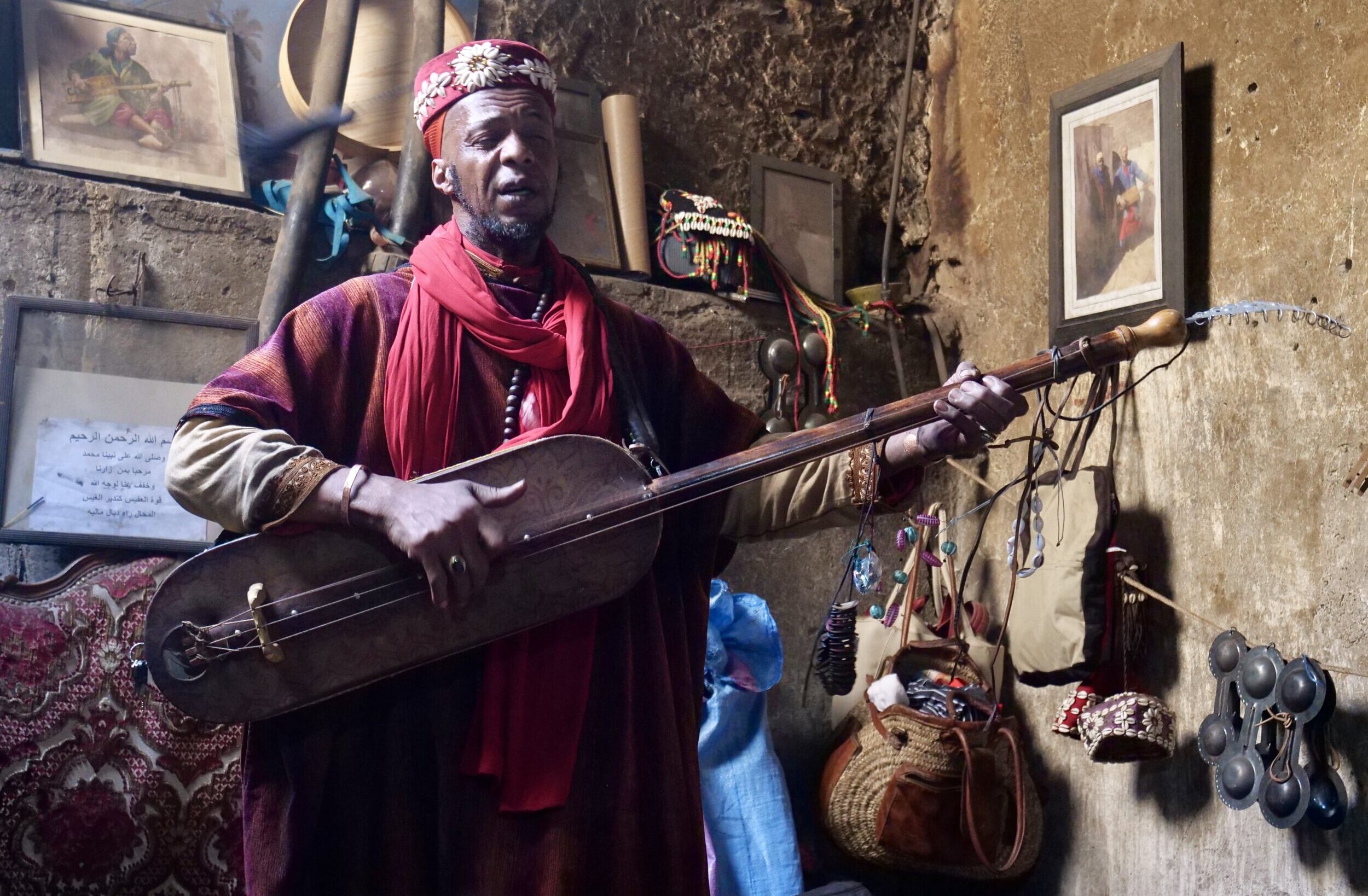
“Gnawa” is the most common of various transliterations into English.
The word refers to a so-called “ethnic group” (albeit one whose members’ ethnicity is not in fact singular), a member thereof, the Sufi brotherhood to which many Gnawa men belong, and – most especially – to a musical genre which is distinctive, mesmeric and usually (simultaneously) both “devotional” and “funky”.
As “Flamenco” is to the global perception of Spanish music, “Gnawa” is to how the world perceives Morocco’s: “emblematic”.
For many foreigners, flamenco is the only Spanish musical form that rings a “bell”.
Most foreigners cannot name any Moroccan genre; if they can, chances are it will be Gnawa music.
In each case, the genre’s emblematic national status is highly paradoxical.
We encountered the pictured individual in Marrakech on 18 October 2025.
In addition to his “Gnawa” role – in all senses detailed above – he is the resident caretaker in a venerable bath-house/ community oven/ commercial bakery.
(The availability of in-house hot water in most local homes has reduced the demand for hammams’ bathing facilities, but this one’s wood-fired oven is still put to good use)
A future, multi-image post will show and tell more about Gnawa culture and history.
Suffice for now that the ancestors of today’s Gnawa musicians/adherents arrived in Morocco as slaves – black Africans transported across the Sahara, or via ships, from various lands south or southeast of the world’s largest desert.
Flamenco in Spain is similarly paradoxical – that nation’s now-“emblematic” music is also the fruit of a “persecuted minority group” – of a “foreign” people who arrived from far-distant places, and who for many generations thereafter were oft-despised, maltreated “outsiders”.
It lacks English language subtitles, but the video below offers a vivid presentation of the Gnawa’s history, music and culture: