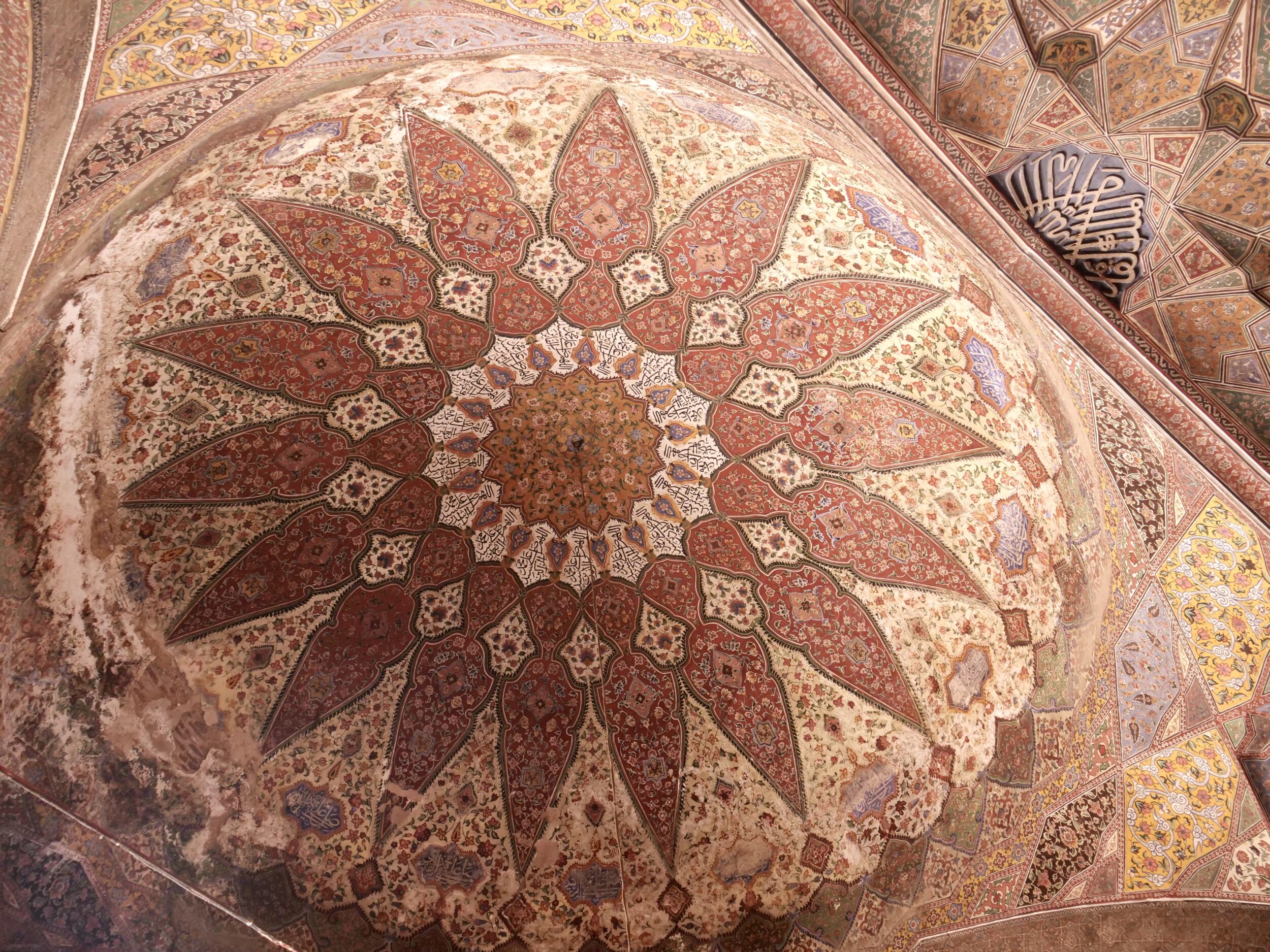
No photograph can do them justice.
(and “serious” attempts to do so would require equipment that very few people possess)
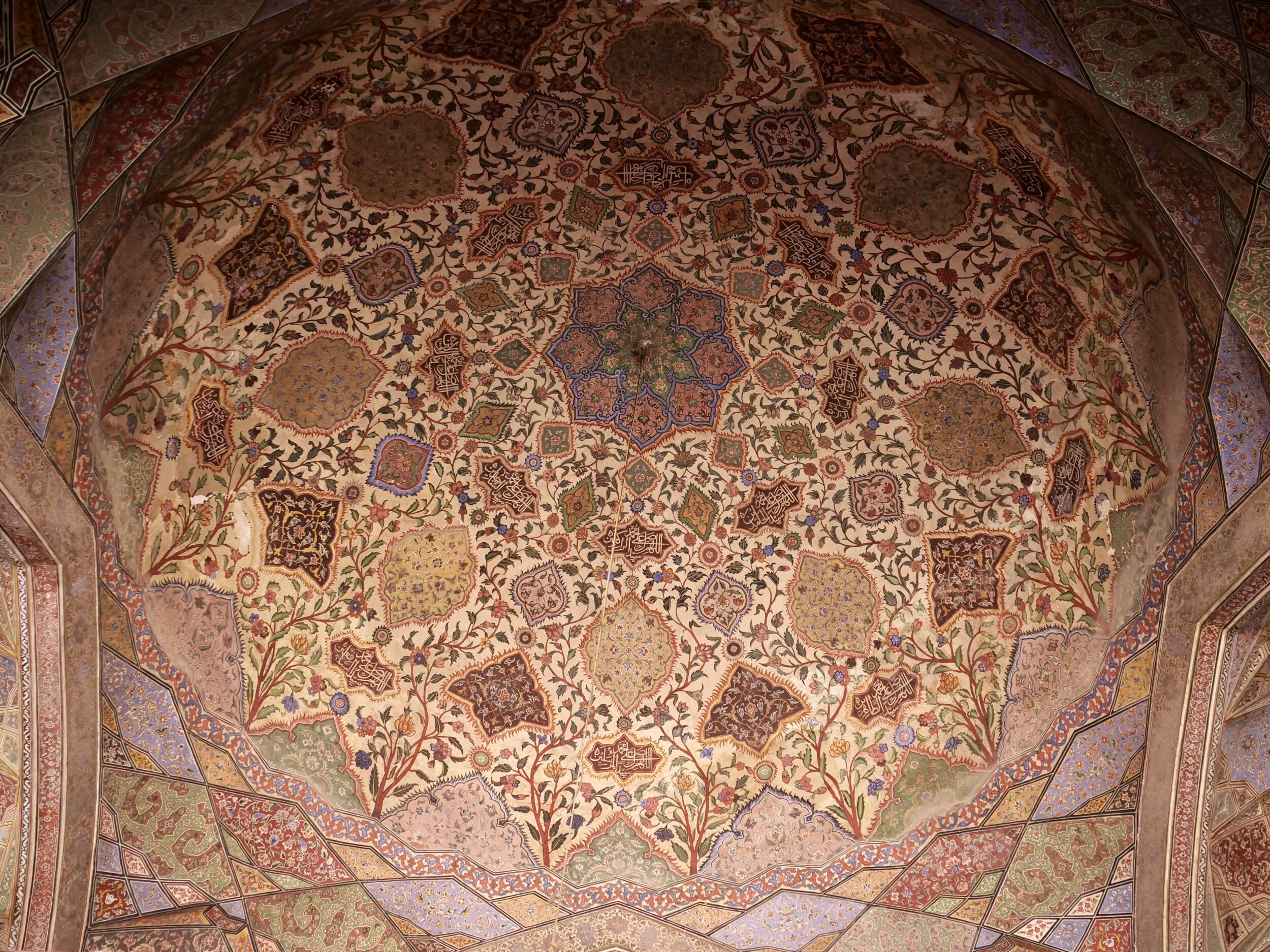
However, the frescoes which adorn this mosque’s domes are guaranteed to amaze and delight almost anyone who looks up at them.
“Fresco”, properly, does not mean “anything painted onto a wall or ceiling”.
A definition:
Fresco (pl. frescos or frescoes) is a technique of mural painting executed upon freshly laid (“wet”) lime plaster. Water is used as the vehicle for the dry-powder pigment to merge with the plaster, and with the setting of the plaster, the painting becomes an integral part of the wall.
The above is from a detailed Wikipedia entry; nobody knows exactly where and when fresco began; certainly, it was thousands of years before the European “Renaissance”, and the relevant location was not necessarily in Europe.
A few non-expert thoughts on “restoration” efforts
Inevitably, it is simply impossible to achieve “complete” restoration of any venerable structure, precinct, or of any particular “culture”, “society” or “civilisation”.
Even were it possible, it would be a very bad idea; should slavery, caste, and ritual killings be reintroduced to Giza in order to offer tourists an “authentic” experience of Ancient Egypt?
By their very nature, cities are dynamic – over the centuries, they change, often radically.
Sometimes, radical change takes place over very much shorter periods. Lahore in 1947 was a case in point. (as was St Petersburg/Leningrad, repeatedly – most especially at “key moments” of the 18th and 20th centuries)
It is simply monstrous (albeit not rare) to ignore the wellbeing of residents whose presence and daily existence has become “an impediment” to “restoration”.
Tensions and contradictions are most especially evident when funding and governance of “restoration efforts” are as much about “maximising tourism potential” as they are about “preserving great examples of humankind’s built heritage”.
Such issues/tensions/contradictions/problems are abundantly present in Lahore, but not uniquely so; if one cares to look closely, such issues are inevitably present wherever “historic sites” and “manmade wonders” sit within inhabited locales.
And, of course, “all of the above” are “live” and fraught, even before one considers a restoration-proper’s “accuracy”, quality, aesthetic sense and scholarship – or lack thereof!
Further consideration of all the above will be included in some of this series’ forthcoming chapters.
Next stop: the painstakingly-restored Shahi Hammam – the “Royal Baths” that were originally operated by (and part-funded) the nearby Wazir Khan mosque.