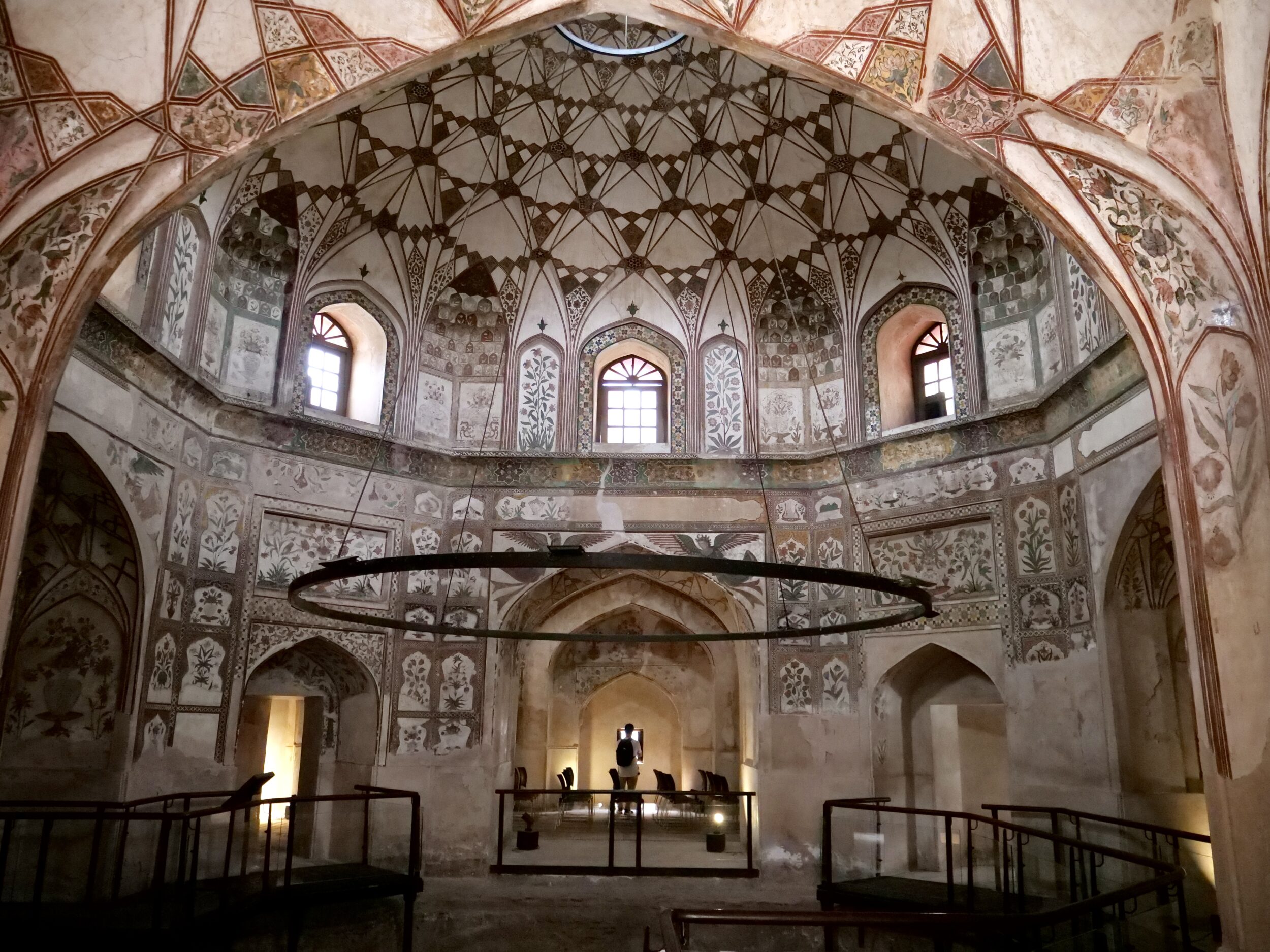
My photo shows the grandest of this monumental bathhouse’s 21 rooms.
The “cold room” was the “entry statement” – the place where public “occasions” and gatherings could occur, separate from the actual baths, their steam, their heat and their need for “privacy”.
Westerners tend to call any such building a “Turkish Bath”.
Turkey, however, never had a monopoly on public hot baths. (nor did Asia. For example, the English city of Bath is so-named after the public baths constructed by its Roman conquerors)
As tended to be true of Mughal Empire structures on the Indian subcontinent, this building’s aesthetics are somewhat eclectic, but the predominant “accent” of the Shahi Hammam is “Persian”…definitely not “Turkish”.
As previously acknowledged, any major “heritage restoration” projects within any living city are “problematic” in terms of their impact on those who live within or near to the relevant “sites”.
As a visitor, I simply do not know enough for me to pass judgement on how well – or otherwise – that issue has been addressed by the Walled City of Lahore Authority, aka “the WCLA”.
Even were I a resident of Lahore, I am 100% certain that my fellow residents would hold a raft of many different opinions on this subject.
An “autonomous body”, the WCLA was established in 2012, with three key objectives:
- Establish a comprehensive legal framework and specialized institutions for conserving the heritage (tangible and intangible) of the Walled City of Lahore.
- Enhance the quality of life for residents by streamlining business activities and commercial operations.
- Promote tourism and highlight the unique aspects of the Walled City of Lahore.
With all of the above in mind, you may like to click here for a local, withering critique of the WCLA.
The WCLA’s own description of the Shahi Hammam, before its restoration:
Over the years, Hammam had lost its originality and beauty. The meticulously done fresco work, by the master artisans of the Mughal era, was covered with lime wash in later years. The original hypocaust system (a system of central heating in a building that produces and circulates hot air below the floor of a room) was covered with marble and cement in order to use it for offices and other purposes. Similarly, different rooms with system of steam bath, hot bath and washing areas were also made dead and used as offices. Thus, the entire hammam was dead and nothing functional or preserved could be seen.
To my eye, at least, the restoration effort has been meticulous, historically well-informed and well-explained, and has not been “overdone”.
In our travels in Pakistan, we were generally very favourably impressed by the degree of care evident in “heritage restoration”.
In not a few cases, one could wish that more funds had been available, and that the restoration efforts had commenced a great deal earlier.
One often had reason to lament what had been totally lost, or “fatally” ruined,
Those caveats notwithstanding, wherever we saw actual “heritage conservation efforts” in Pakistan, the results were not “Disney-esque”, “crude”, “ill-considered”, “propagandistic”, or inept/slapdash.
(in more than a few other lands – our own, occasionally included – we have seen a deal of “heritage restoration” that richly deserves most or all of the above derogatory adjectives)