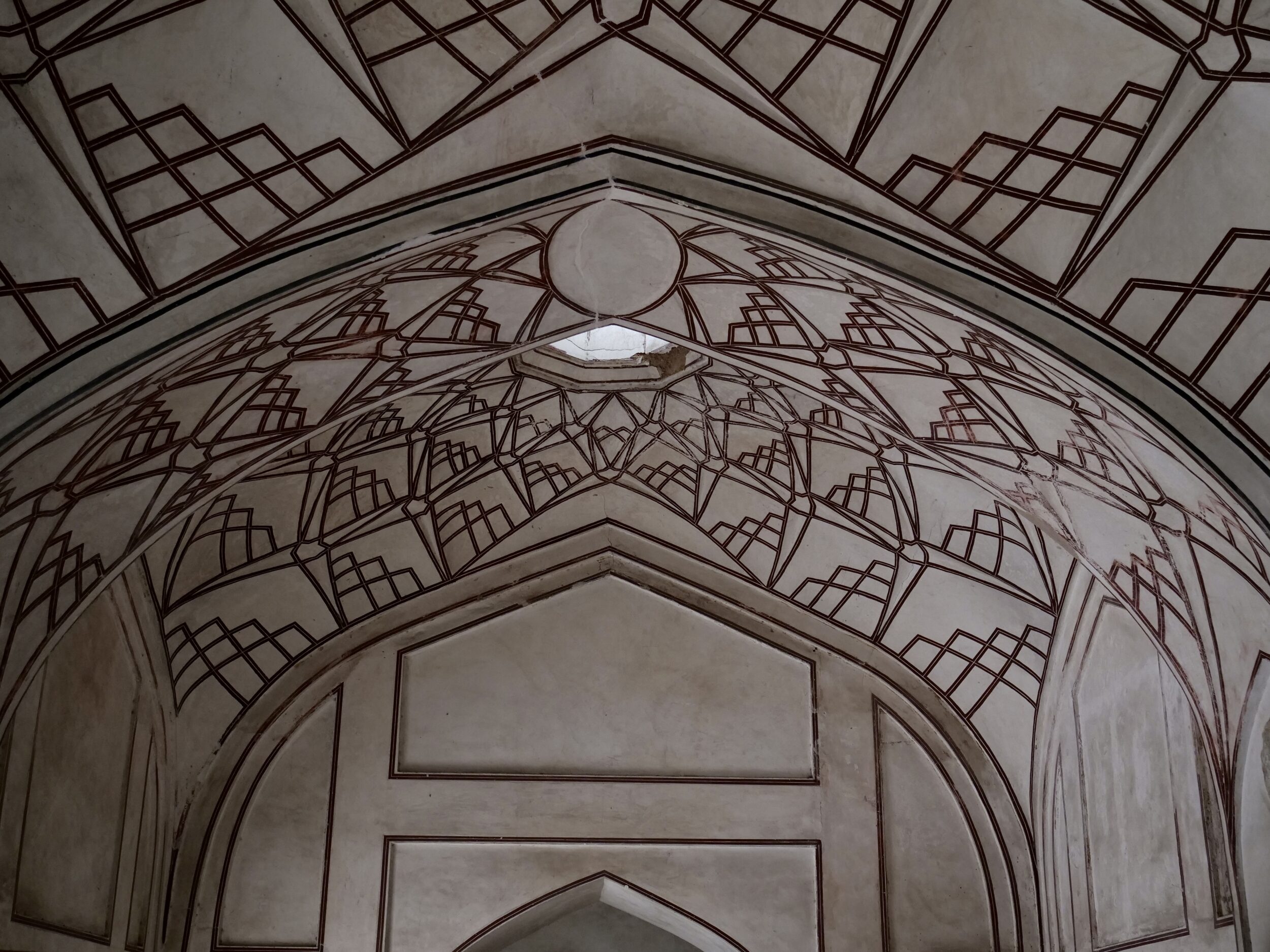
The Shahi Hammam’s smaller rooms’ decorative frescoes – as illustrated in this post’s featured image – are geometric/“abstract” and very “spare”.
They are no less beautiful than the big rooms’ much more elaborate and oft-“representational” frescoes.
Contrary to widespread belief, Islam does not impose a blanket ban on “representational” visual art in general, nor on the depiction of humans, specifically.
For instance, “Persian miniature” – one of the best-loved, most influential forms of visual art – was fostered by Muslim rulers; a key feature of the genre is its depiction of (non -sainted) human beings.
That said, what you can see below is something that would never have been approved.
It is a cheeky, “improper” bit of egocentricity on the part of one anonymous artist/artisan.
Also worth noting: it has never been erased.
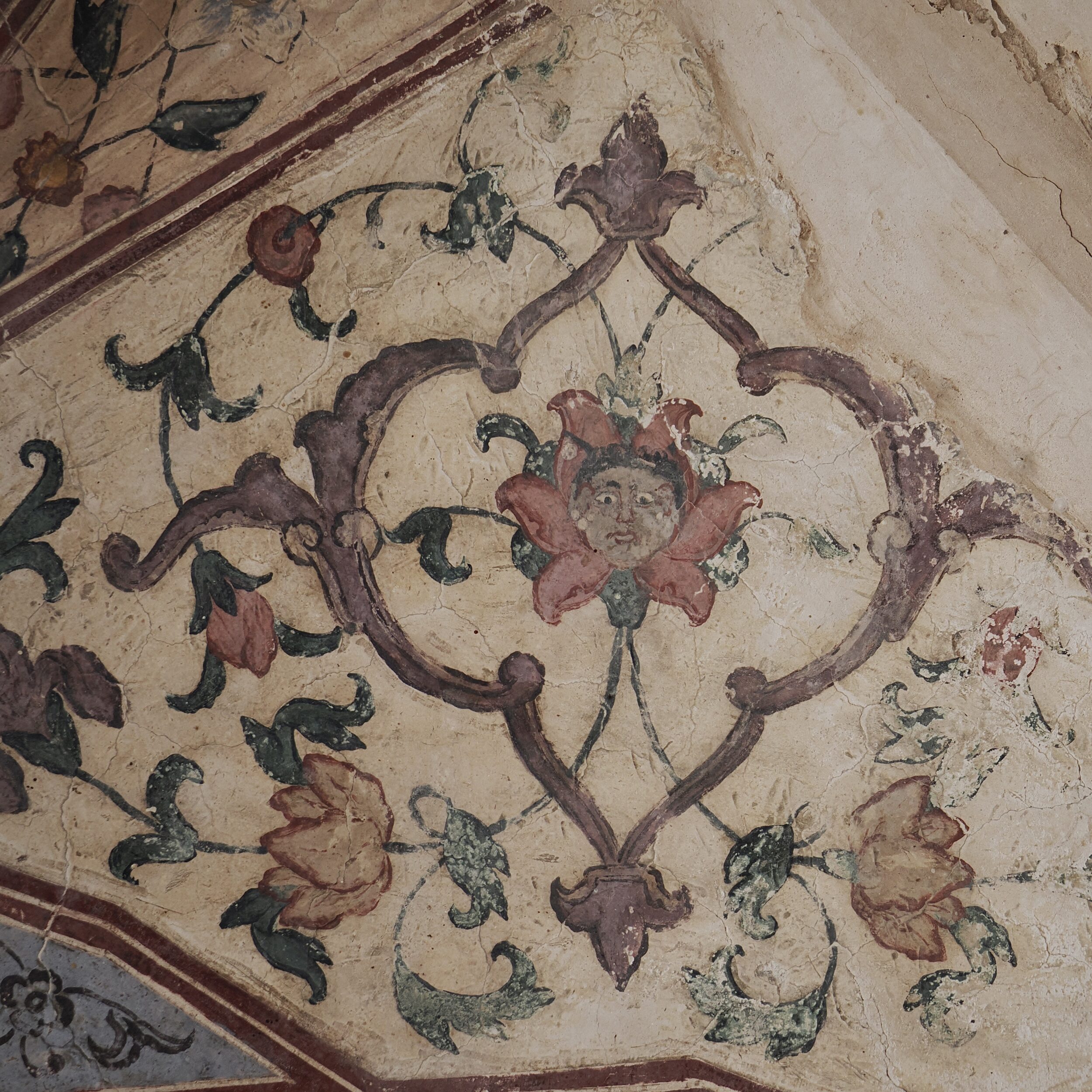
The Mughal Empire’s cities on the Indian subcontinent were global centres of artistic and architectural excellence.
They attracted and employed artists and artisans from far-distant places, including Western Europe.
Some of those artists/artists liked to leave behind a “signature” or “tag”/“graffito” to record the fact of their particular effort.
Islam, Christianity and Judaism are all monotheistic.
However, none of them is monolithic.
Within each faith it is very easy to find all manner of hugely-divergent attitudes to various modes of visual art, dancing, music, “difference”, sexuality, gender, dress…you name it.
Click here for a succinct, myth-busting essay on “figural representation in Islamic Art”.
Its opening paragraph:
Many people believe that the representation of figures is forbidden in Islamic religion and culture, but this is false. The Qur’an, in fact, has extraordinarily little to say about art and admonishing against the representation of figures. However, this misconception exists for a reason, and there are several circumstances that lead to it: