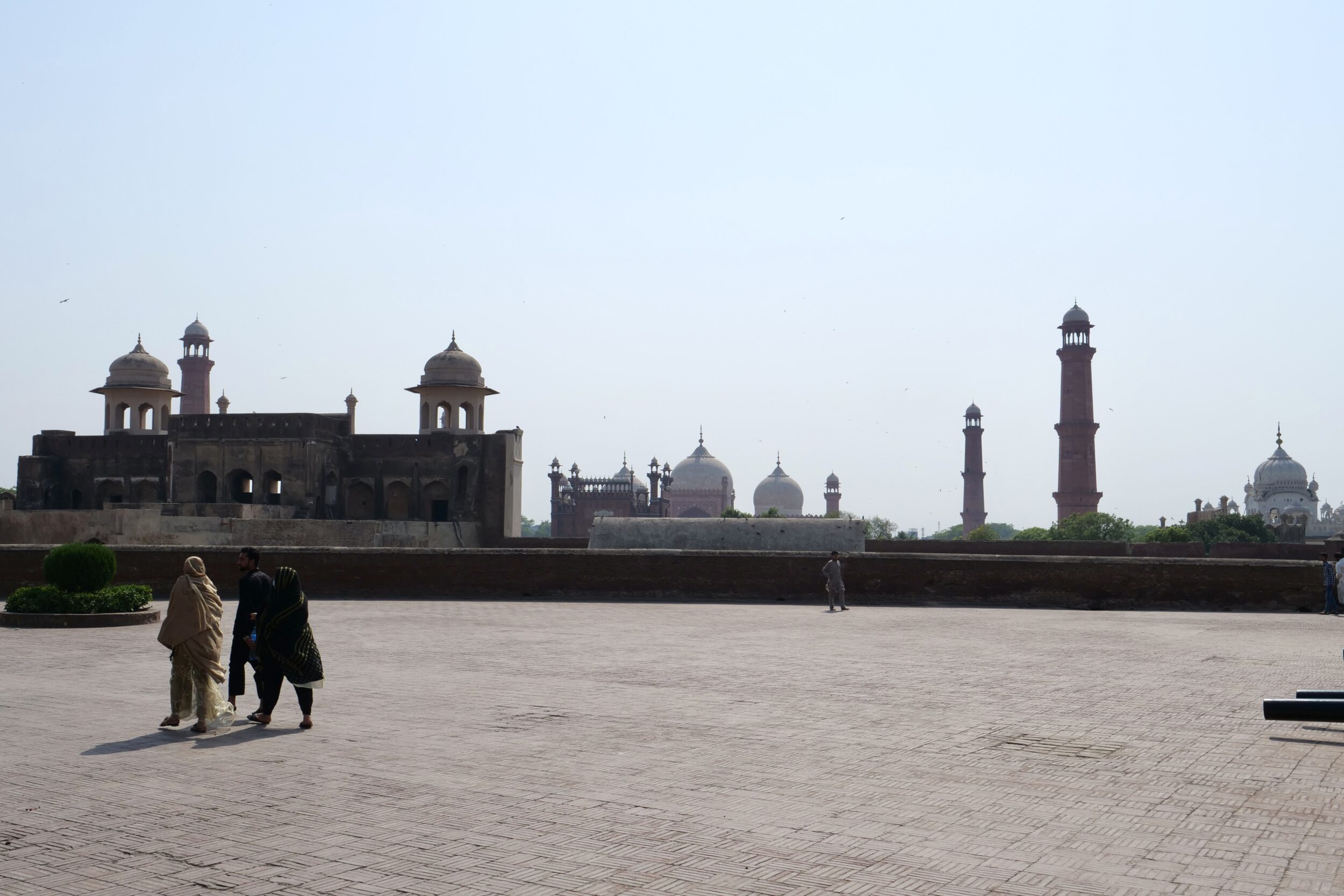
At 3pm on 12 May 2024 we were “upstairs”, in very bright sunshine, making our way to the Sheesh Mahal.
If the “selfie index” is any guide, this “palace of mirrors” is 21st century tourists’ favourite of the 21 “notable monuments” within Lahore Fort.
We’ll reach it in this series’ next (selfie-less) chapter.
Meanwhile, take a close look at the various structures visible in this chapter’s featured image…
You may imagine that you are looking at several mosques.
In fact, the structure on the left of the photo is the interior side of the grandest of Lahore Fort’s gates.
In the middle – outside of the fort, but still (just) within the Walled City of Lahore – is a mosque.
At the time of its construction it was the world’s largest mosque; more than 350 years later, Badshahi Mosque (this series’ final attraction) is still one of the world’s grandest mosques.
On the right is the Samadhi of Ranjit Singh: the mausoleum/tomb of a 19th century Sikh Maharaja who founded a short-lived empire, with Lahore as its capital.
Under his rule – indeed, through most of the city’s long history – Lahore was a multicultural metropolis.
In 1947, immediately before Partition, Muslims likely comprised a little less than 70 percent of its population. Hindus and Sikhs accounted for the overwhelming majority of the remainder.
Now, more than 95% of Lahore’s population is Muslim, and most of the remainder is Christian.