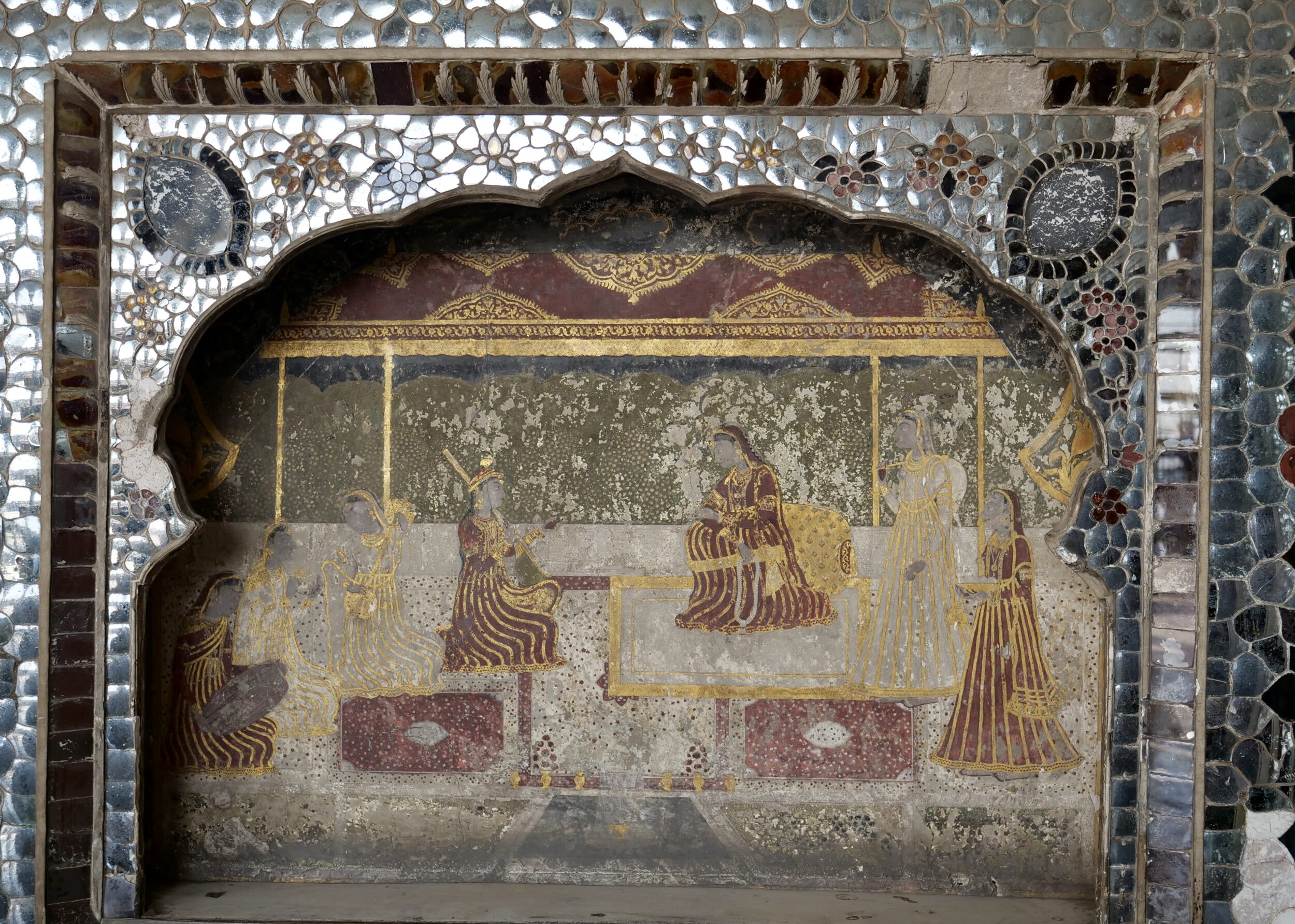
Lahore Fort’s Sheesh Mahal and Agra’s Taj Mahal were both commissioned by the same Mughal emperor.
Each expressed – mostly, in white marble – his abiding love for his favourite wife.
Shah Jahan (1592-1666) had three wives, but only one marriage was a “love match”.
He renamed his beloved, “Mumtaz Mahal” – “the exalted one of the palace”.
Allegedly, Mumtaz Mahal had a dream/vision of heaven; the Sheesh Mahal was her husband’s attempt to make that dream “real”.
Shah Jahan was the fifth Mughal monarch; he was Emperor of Hindustan from 1628 to 1658.
It is generally reckoned that this period was the “golden age” of Mughal art and architecture, and that he was its primary enabler.
As is clearly evident in this post’s featured images, under this particular Muslim ruler, obviously-Hindu “representational” imagery could enjoy a prominent presence, right alongside obviously-Islamic, more “abstract” decoration.
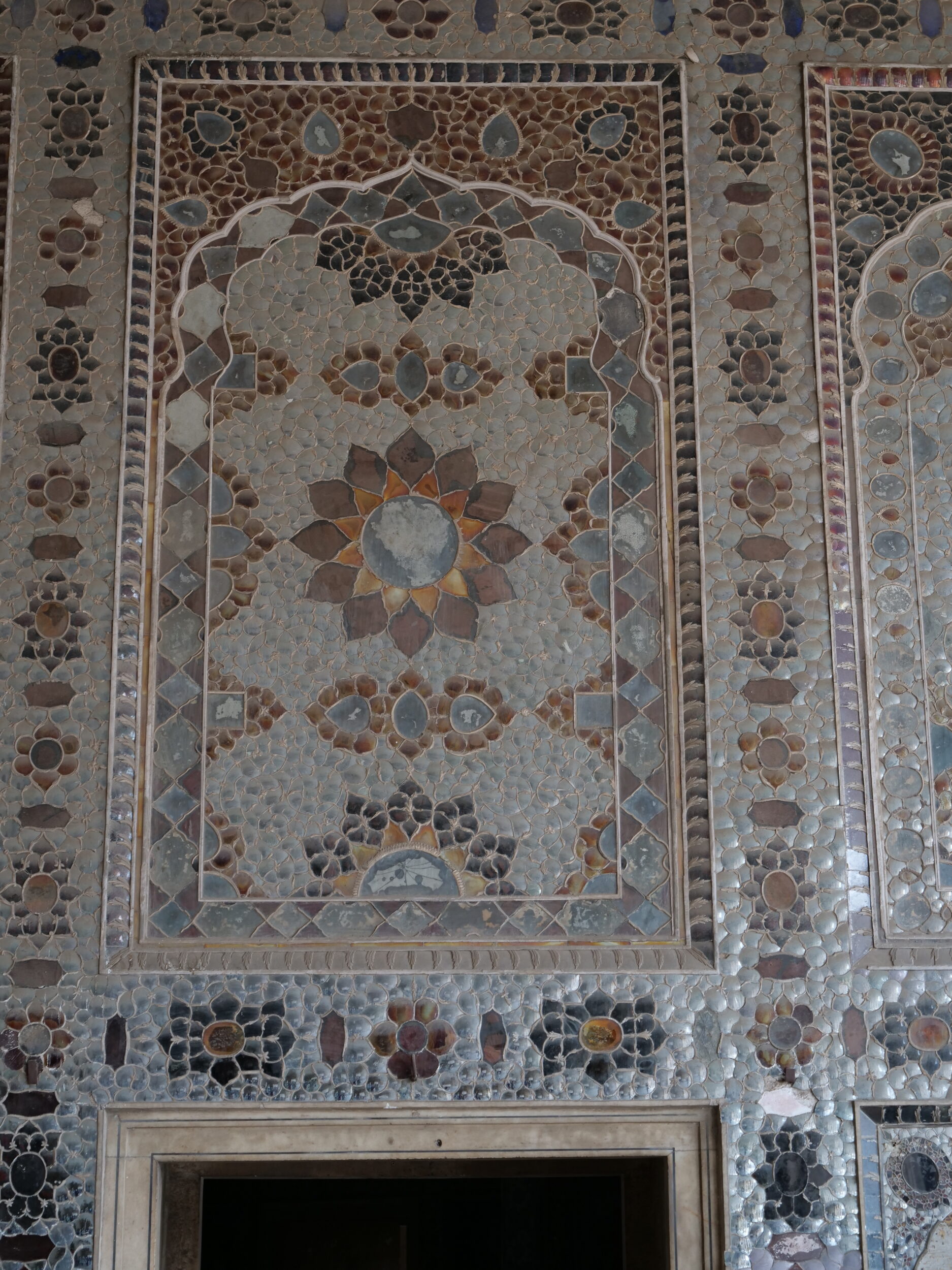
Whereas the Taj Mahal – almost inarguably, the most beautiful mausoleum on earth – was a bereaved monarch’s tribute to his beloved, the Sheesh Mahal was intended to be a palace in which the living Mumtaz Mahal would take great delight.
At age 19, in 1612, the then Arjumand Banu Begum wed the then Prince Khurram.
In 1628 he became the Emperor Shah Jahan and she – now Mumtaz Mahal – became the Mughal Empire’s Empress Consort.
On 17 June 1631, the fourteenth of Mumtaz Mahal’s completed pregnancies proved fatal; a post-partum haemorrhage ended her life at age 38.
Construction of the Sheesh Mahal had begun earlier in that year.
Click this for a Pakistani journalist’s lively account of “the lady behind the Sheesh Mahal”.
Click here for a more sober biography.
Reportedly, Mumtaz Mahal was highly intelligent, politically astute, in some respects socially “progressive”, and exercised an enormous influence upon her husband’s decision-making.
Wikipedia’s Sheesh Mahal entry includes a photo gallery.
This series’ final several chapters will take us “next door”…out of Lahore Fort and into the greatest Mughal Empire mosque.