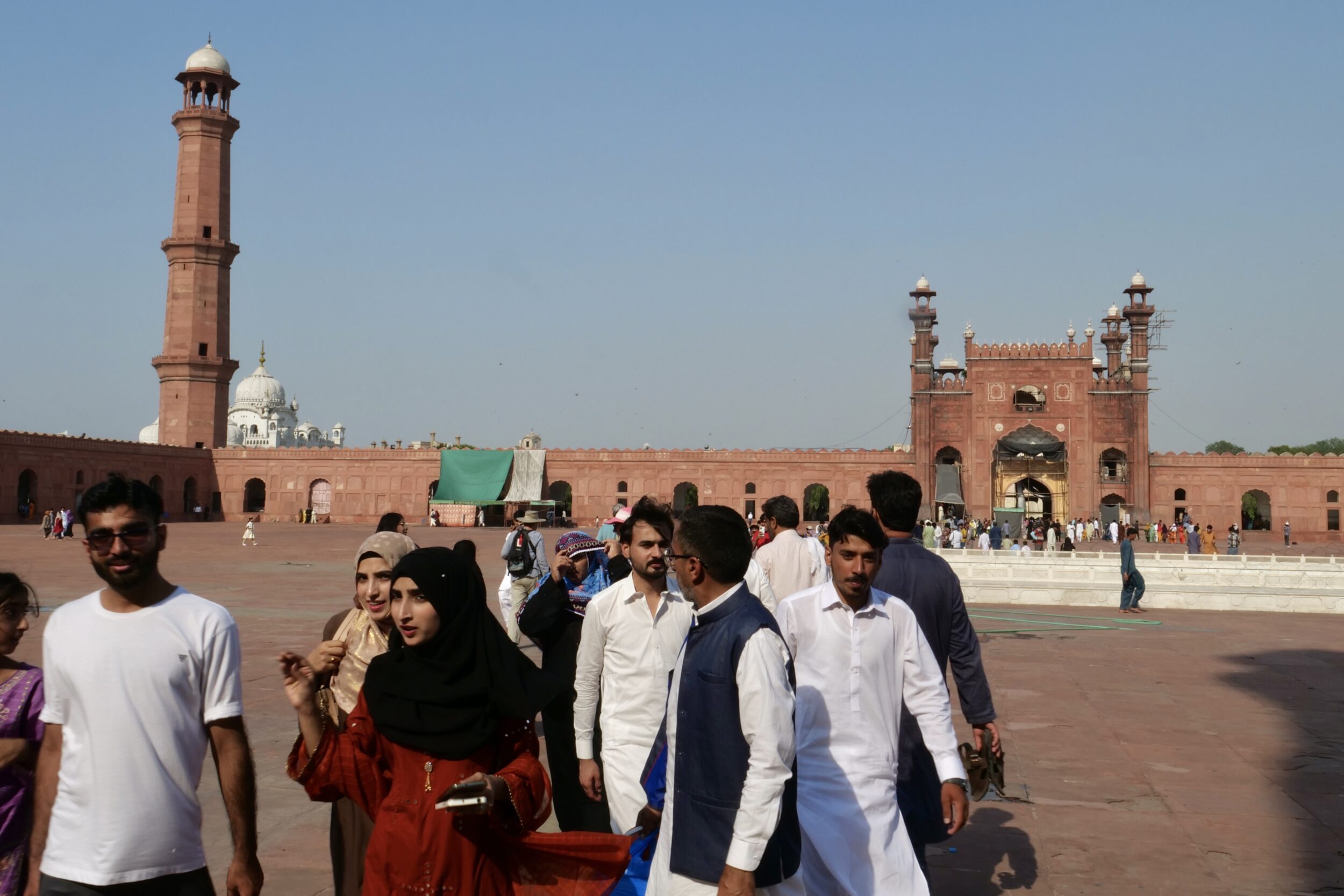
The featured image (immediately above) was taken at 3.47 pm on 12 May 2024; the main building was behind me, as I looked east-ish, across part of Badshahi Mosque’s courtyard.
That paved courtyard’s 25,600 square metres account for most of the mosque’s “footprint”.
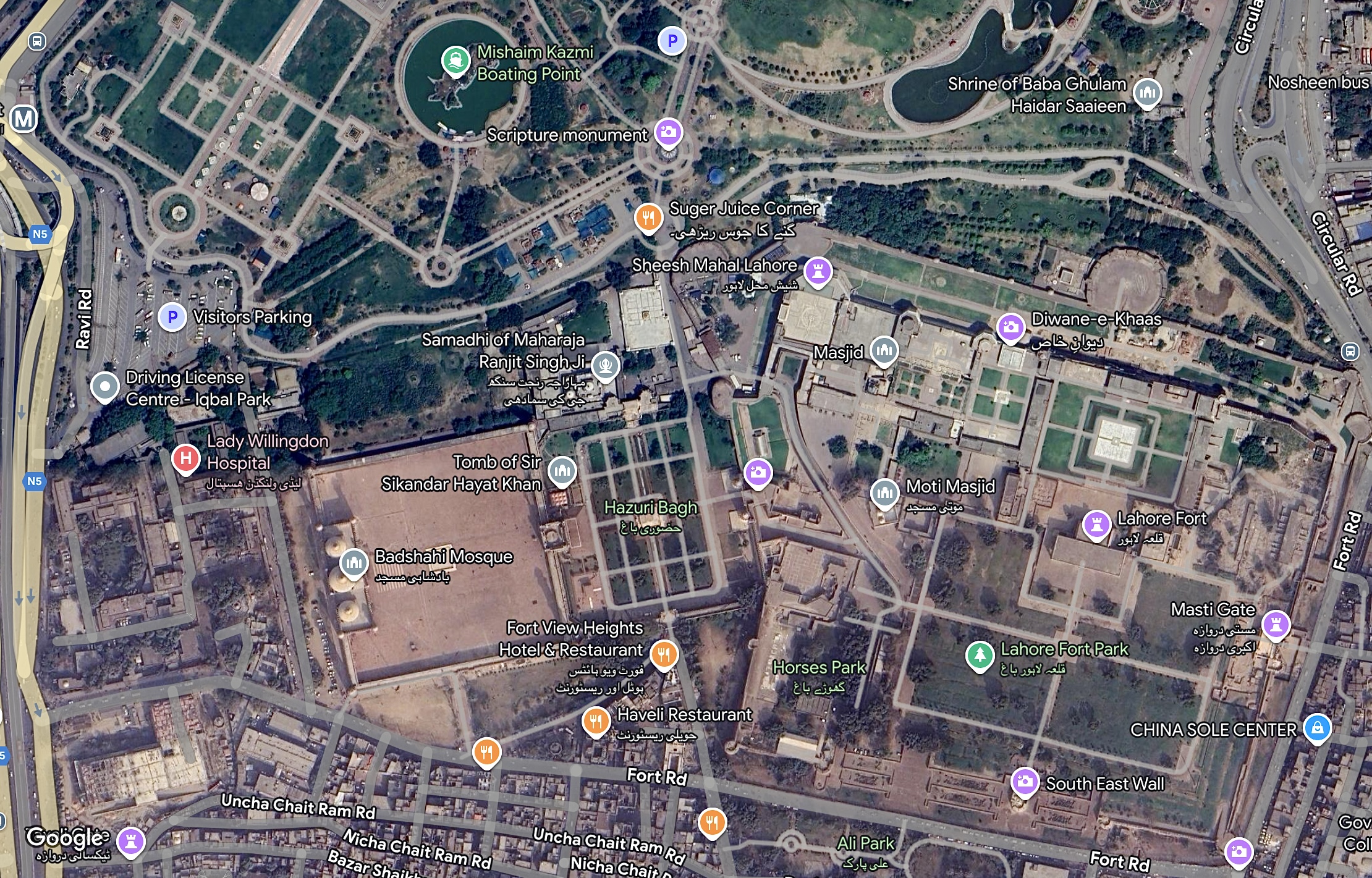
Lahore Fort and Badshahi Mosque are almost adjacent.
Their main gates face each other, respectively, from the eastern and western sides of the Hazuri Bagh – a formerly-“royal” garden which is now a well-loved “public” space.
Lahore Fort and Badshahi Mosque sit on the northwestern edge of the Walled City of Lahore, aka “the old city”.
Having crossed the Hazuri Bagh, passed through the mosque’s suitably-imposing gate, and traversed its courtyard, one enters the main building.
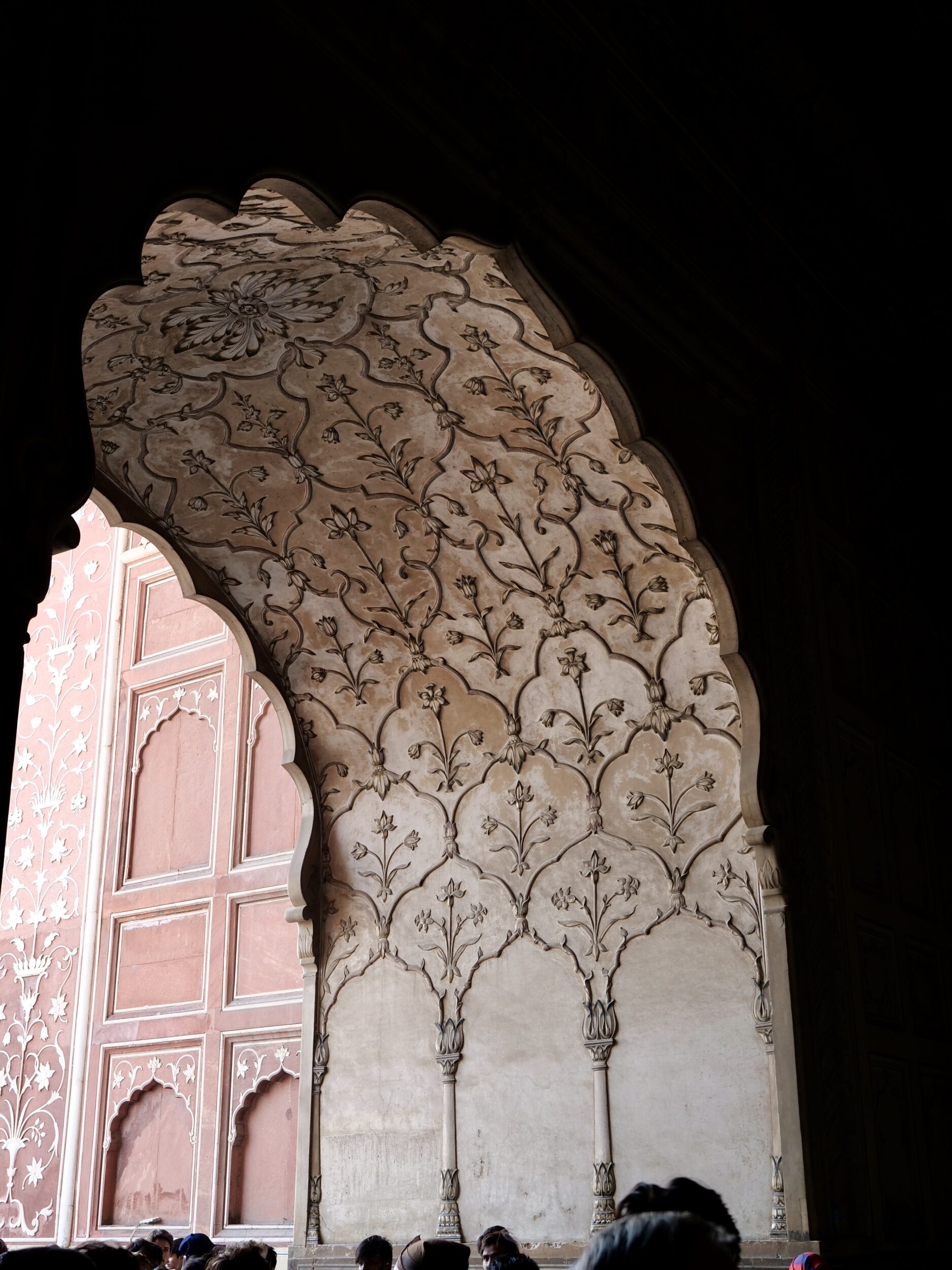
It was neither culturally appropriate nor technically possible for me to attempt to do photographic justice to that building’s extraordinary interior, most particularly the main prayer hall.
However, this article provides both an informative written account and an excellent photo gallery.
—
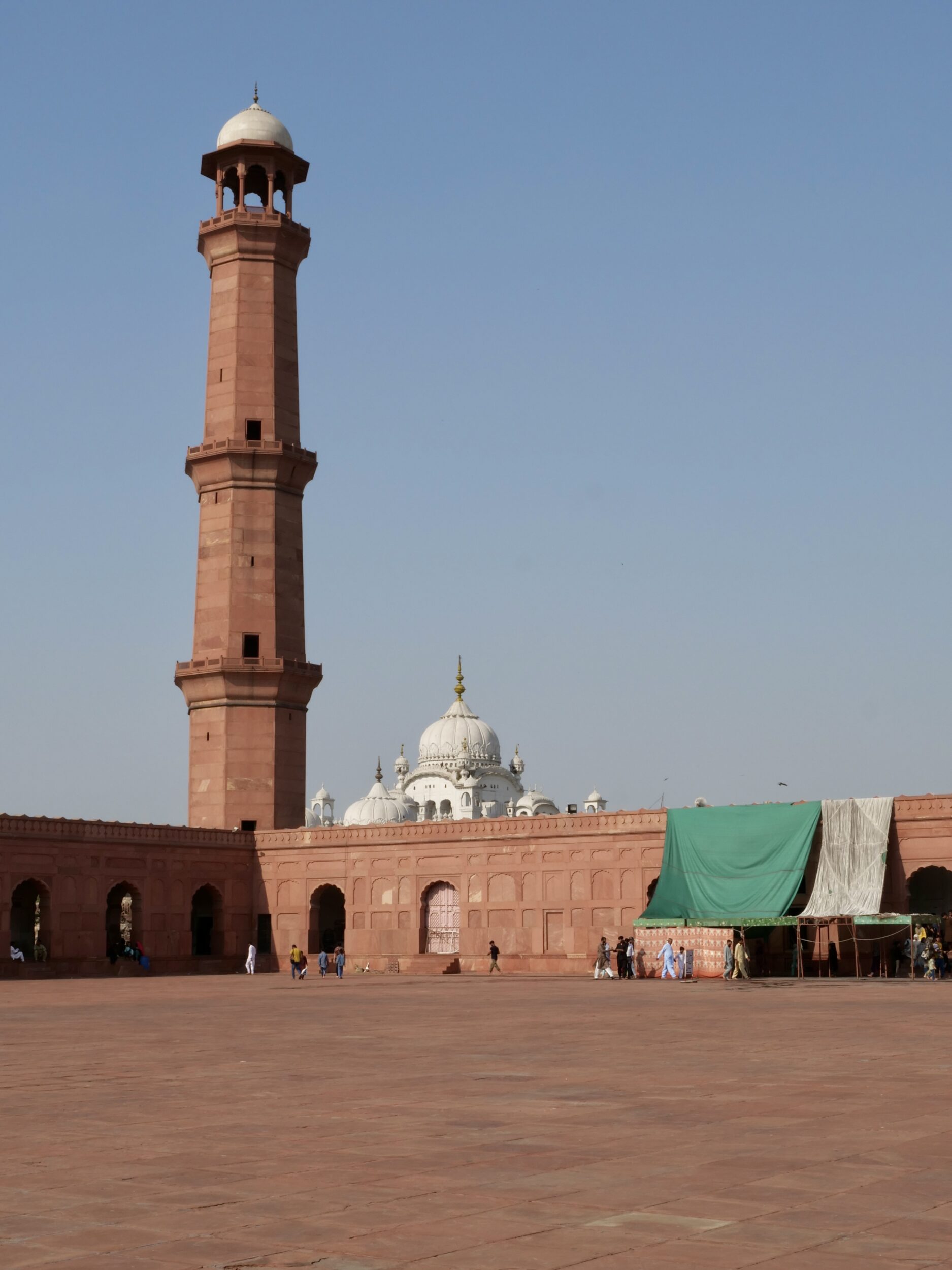
On each of the courtyard’s four corners there is an imposing minaret, 60 metres tall.
As is true of the main building, the minarets are red sandstone structures, topped by white marble domes. The main building’s sandstone surfaces have exquisite marble inlay decorations.
(unsurprisingly, in such a “contested” location, the mosque has suffered a variety of “insults”. During the 19th century CE Sikh and British rulers desecrated it, demolished parts, looted it for building materials, and repurposed it as a military garrison. Later in that century the British “handed it back”, and Badshahi resumed its role as a mosque. Restoration efforts, however, were decidedly half-hearted until a proper restoration commenced in 1939. Only then did the minarets regain their (looted) marble canopies/domes. Full restoration of the main building was eventually “completed” in 2008)
As previously stressed in this series, for most of its long history Lahore was a cosmopolitan city, with substantial numbers of adherents of several religions.
Over the last few hundred years, adherents of three different faiths have ruled over it.
If you look at the photo above you can see evidence of this; the white building, just outside of the Badshahi Mosque, is the Samahi (mausoleum) of Ranjit Singh— founder of the short-lived, Lahore-based Sikh Empire, which reached its apex under his reign.
Ranjit Singh was its first Maharaja, from 1801 to 1839.
As further explained here, the Samadhi of Ranjit Singh is a very eclectic building.
One non-admirer described it as an unhappy mix of Hindu and Muslim architecture.
The sneerer was – presumably – blind to the fact that its architectural “mix”/“accent” was decidedly Sikh! (sic)
—
This post’s Google Earth image shows how particularly well-located is the Haveli Restaurant – a little below the southeastern corner of Badshahi Mosque’s huge courtyard.
From its actual street, that establishment’s exterior looks like this:
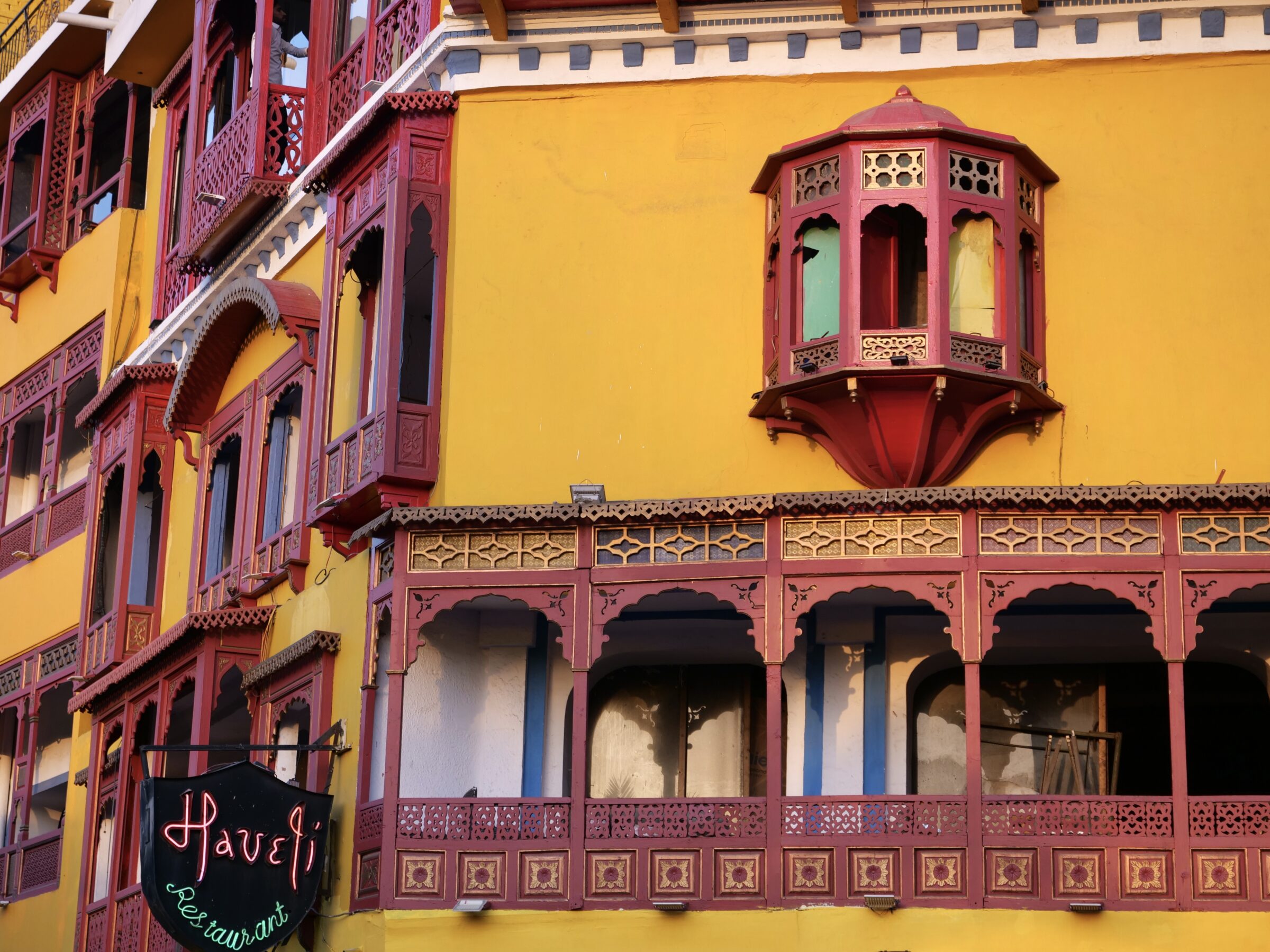
If ever you are lucky enough to visit Lahore, I would urge you to book an outside table, upstairs.
Book well ahead – this is a very popular restaurant,
(You will not be able to drink any wine when “dining out” in Lahore, but delicious food is easy to find)
You should book for circa 30 minutes before sunset.
When it comes to “dinner in a big city, with an unforgettable view”, it is hard to imagine a venue which could surpass “on the terrace at Haveli Restaurant”.
The next two posts will illustrate why I say that.