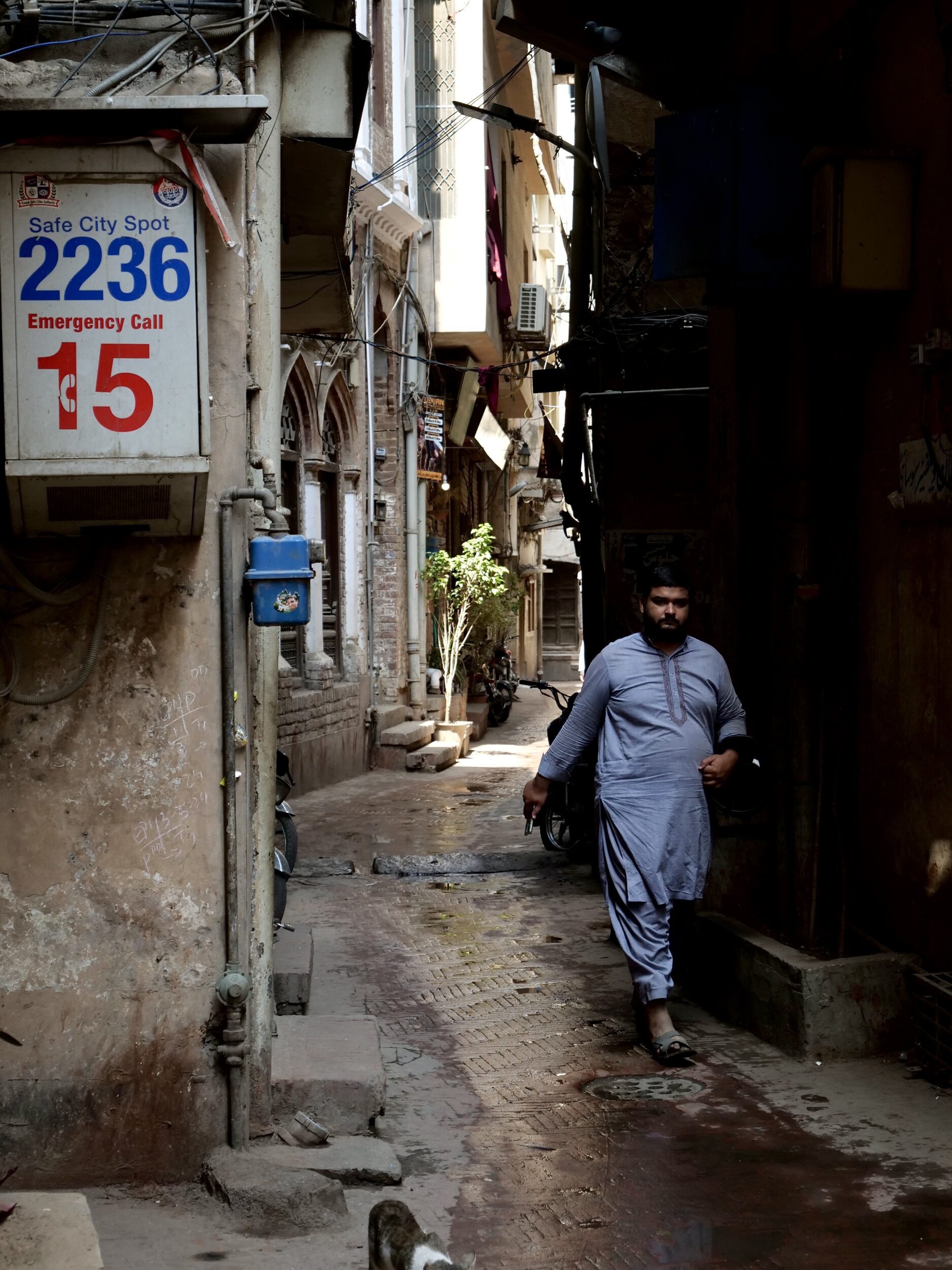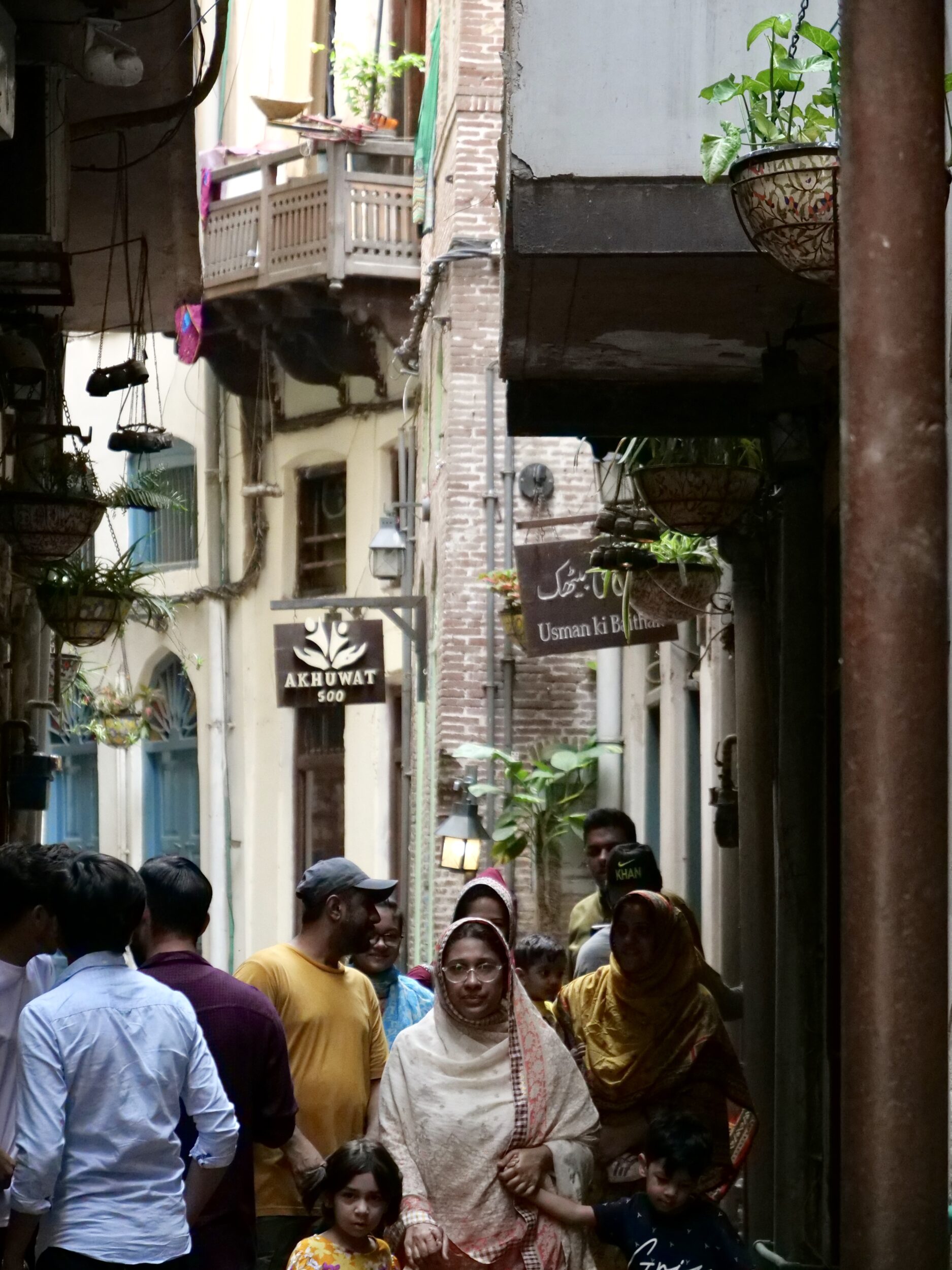
Above, you are looking at the meticulously restored/refreshed Gali Surjan Singh, which is now one of the most “upmarket” streets in the Walled City of Lahore.
This is a street where dining and shopping options are abundant.
For obvious reasons, the same is not true of nearby Patli Gali, pictured below.
Nonetheless, precisely because it is allegedly the narrowest “visitor-friendly” street in Lahore’s entire megacity, Patli Gali is a “must see” for visitors to Lahore’s walled city.
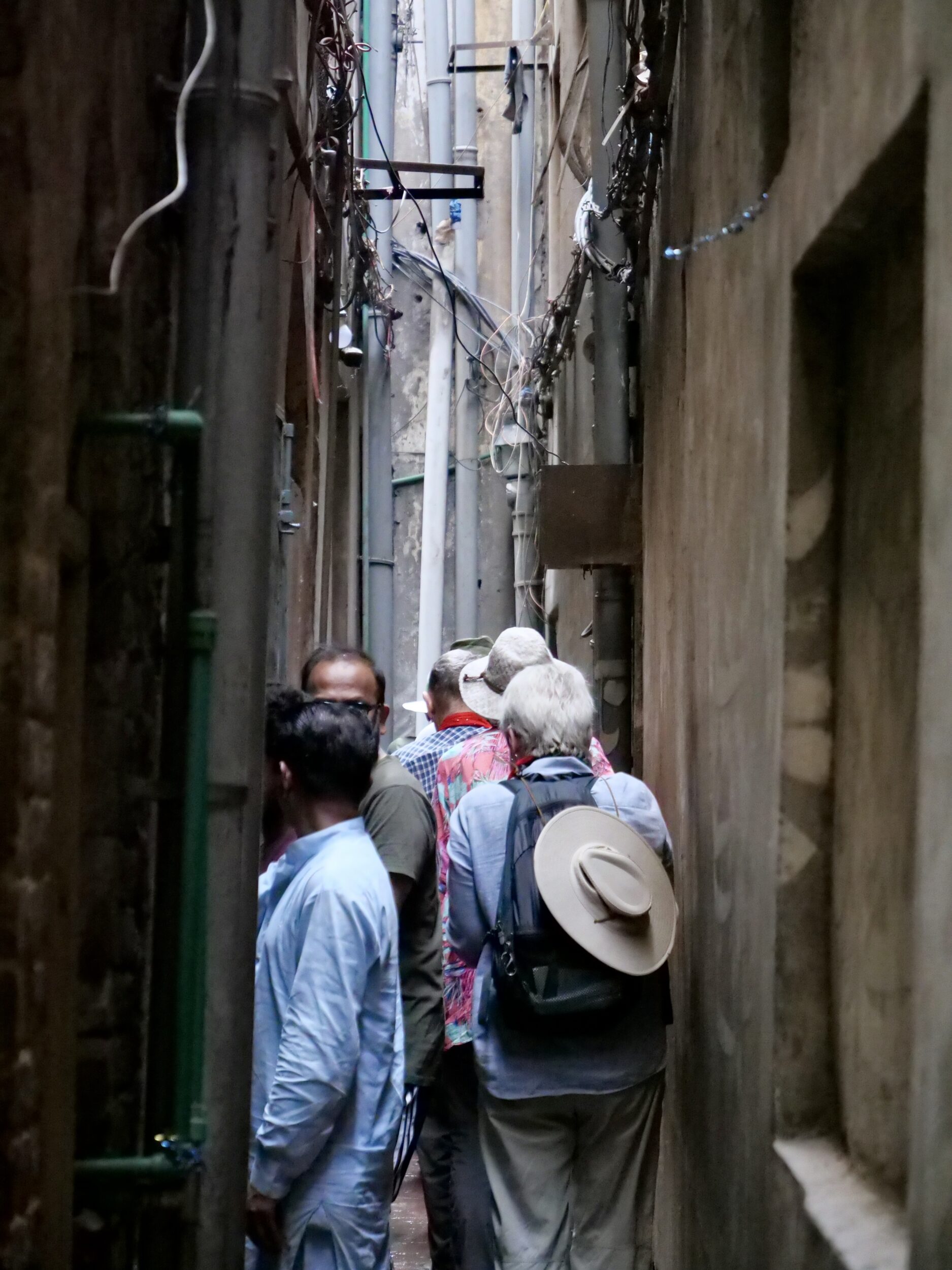
A local joke suggests that if a man and a woman intend to walk this street at the same time – from opposite directions – they ought first marry each other,
Lahore’s walled city has existed for circa 1,000 years.
There is evidence that (within the current megacity’s “footprint”) substantial urban settlement began at least several thousand years before the walled city’s birth.
Most of the walled city’s prized architectural treasures are of 17th century (CE) Moghul Empire vintage.
Immediately before the partition of India in 1947, Hindus and Sikhs made up about 40% of Lahore’s population.
They now constitute less than 1%.
Unsurprisingly, in a young nation born out of a religiously-based “partition”, Pakistan’s now overwhelmingly-Muslim populace and Governments are not pre-disposed to celebrate the reality that Lahore was for many centuries a multicultural city, in which various religions flourished – each with large numbers of adherents and substantial places of worship.
Not all of Lahore’s “precious, but endangered” built heritage – that which merits serious conservation effort – is of Muslim origin.
It is readily apparent to an alert and informed observer that the “non-Muslim” component has enjoyed a lesser (albeit, definitely not zero) degree of serious conservation effort.