(The musical bonus features a man who was very possibly the greatest tabla player in recorded history. It is hard to imagine that there has ever been a more prodigiously gifted player of any drum. I am around 99% certain that you have never heard of him, let alone heard him. For the final 49 of his 66 years he lived in Lahore)
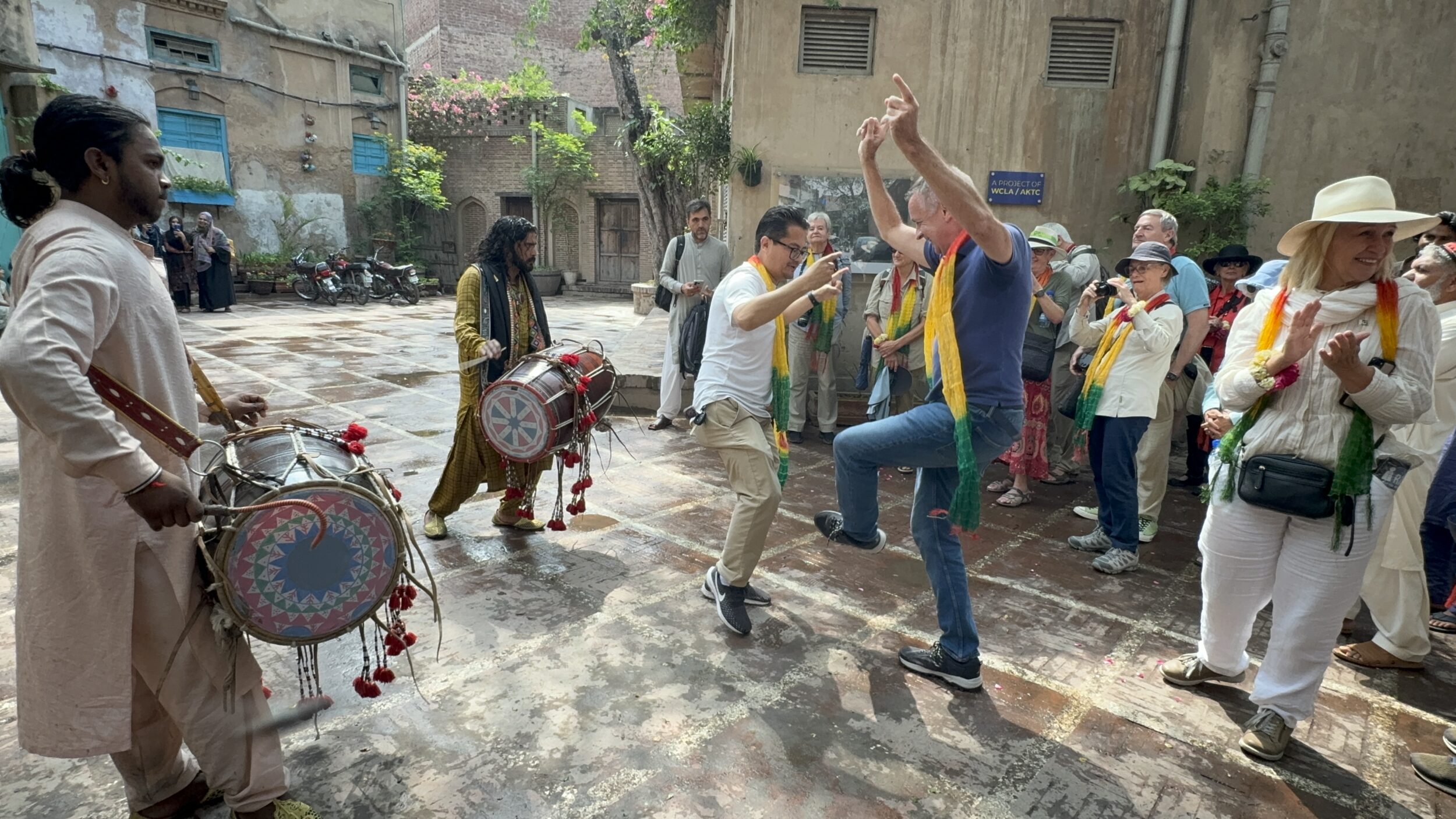
Immediately after our more “formal” welcome, we were made even more welcome, more personally, in a courtyard adjacent to Delhi Gate.
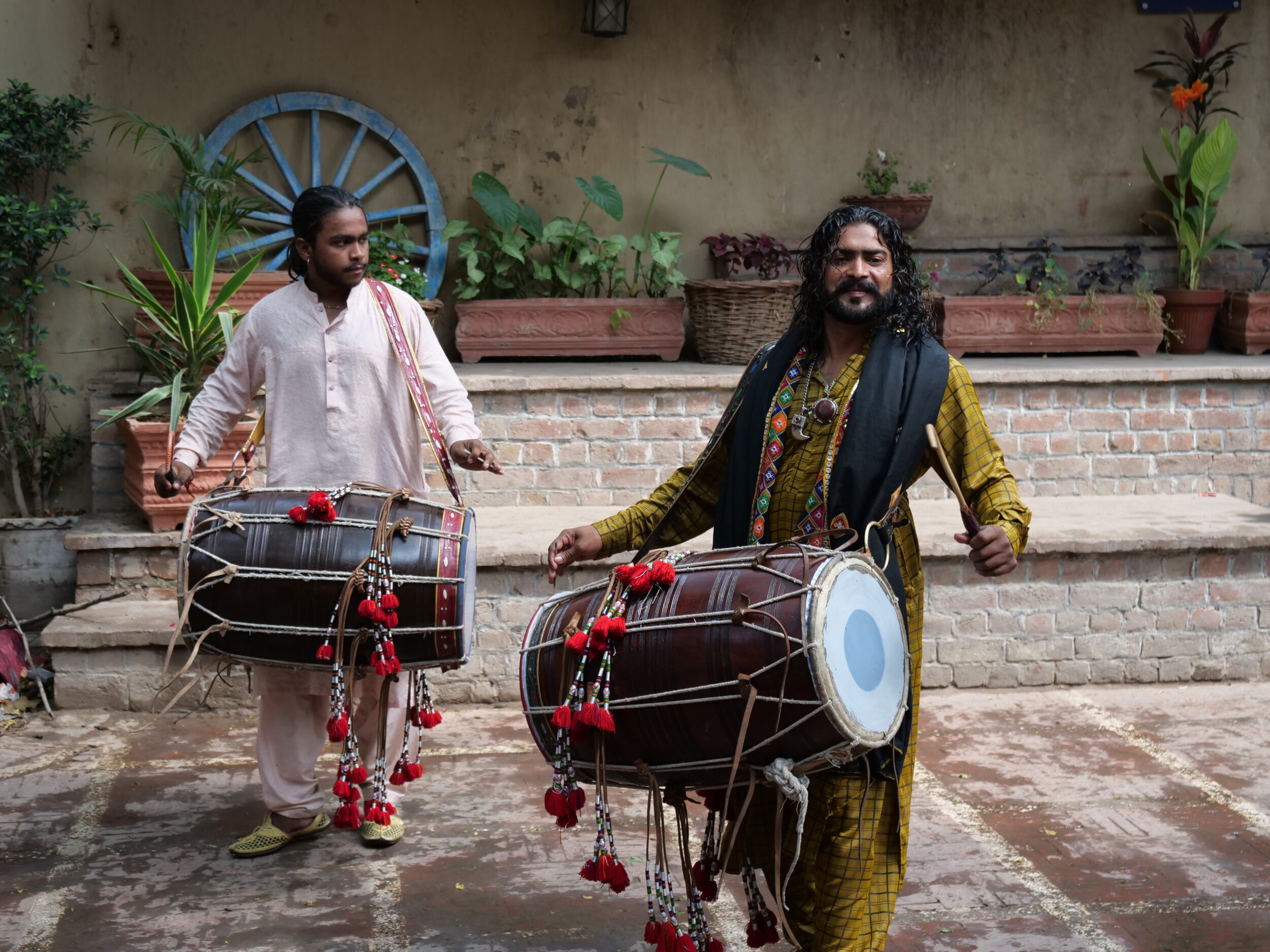
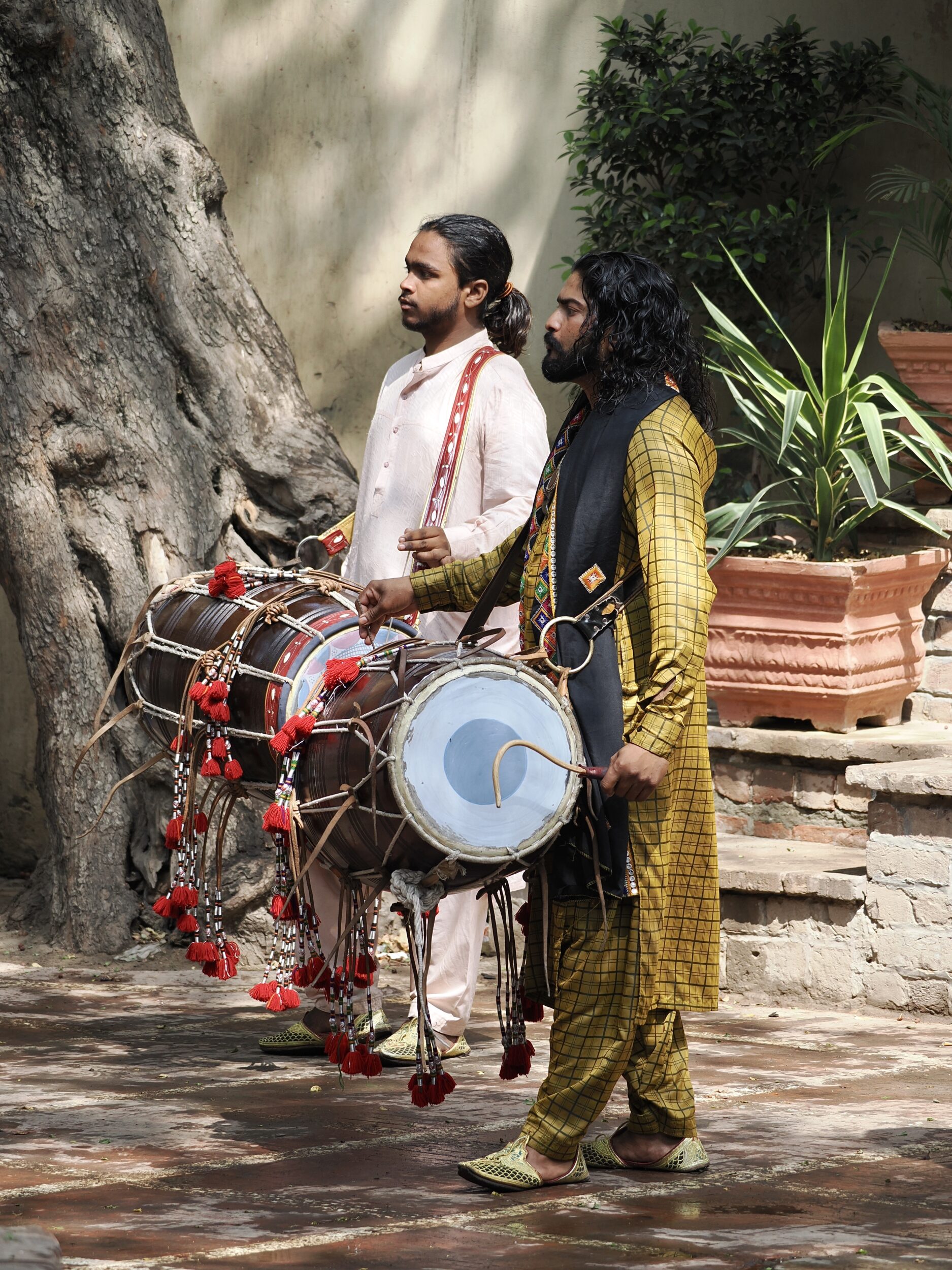
Drums and garlands were involved.
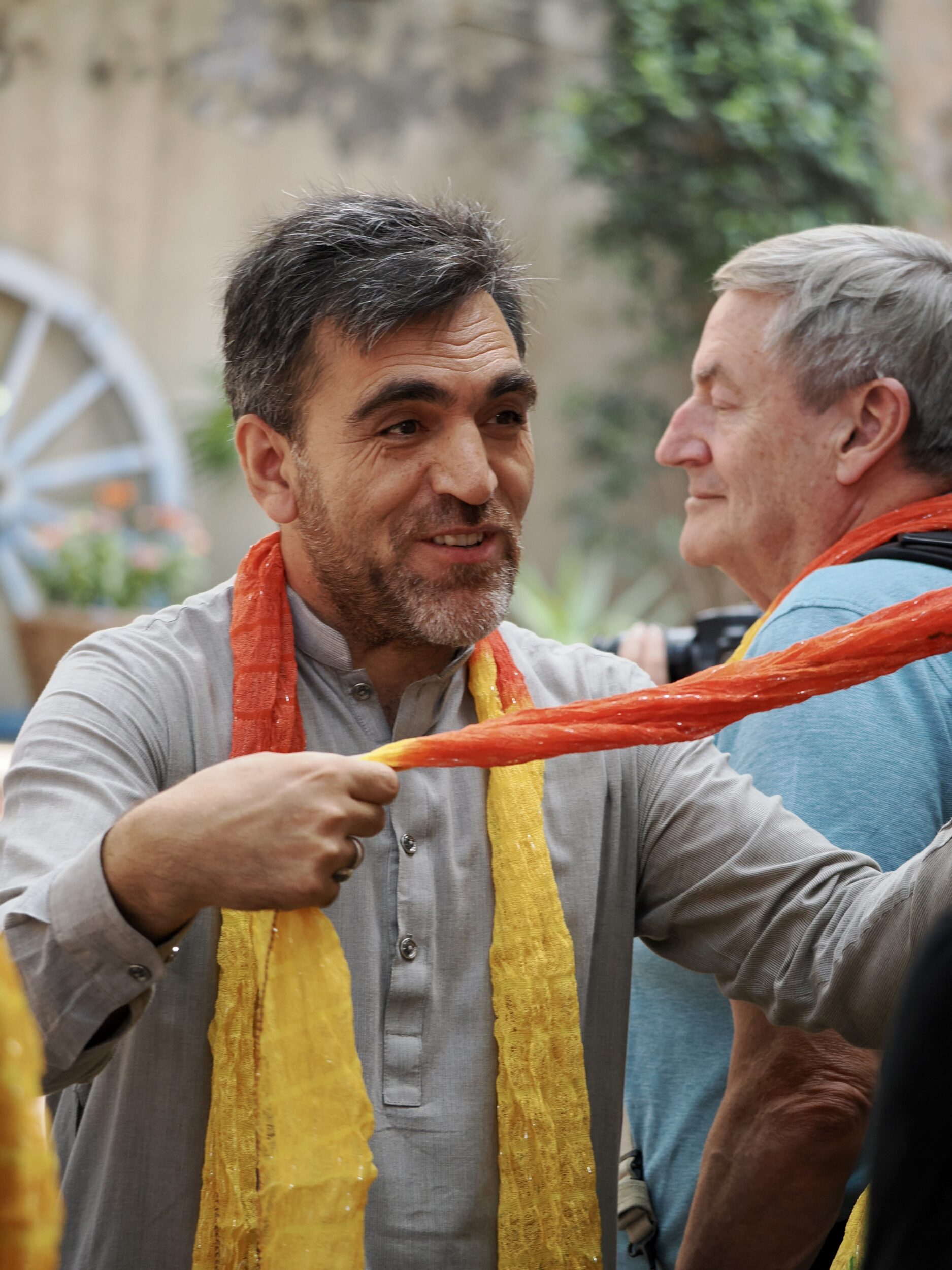
This “happening” happened for our benefit, but it took place in a precinct where the overwhelming majority of persons present are “locals”, not tourists.
As you’ll see in the next chapter, some of them also enjoyed “our” event.
Lahore’s status within Pakistan is analogous to Kolkata’s within India.
Both are megacities, each bigger than any European metropolis, but neither is the largest in its own nation.
Lahore is #2 in Pakistan.
Kolkata is #3 in India.
Each is generally considered its nation’s “cultural capital”, most especially in relation to “erudite” music.
—
Musical bonus
When Australians hear the words “Punjab” or “Punjabi” most immediately think of a state in northern India…and of the many people who have emigrated from there to Australia.
Pre-1947, Punjab was a very large province within British-ruled India.
The biggest-ever emigration by Punjabis occurred in 1947, when their province become two provinces of the same name – in two newly-independent nations that instantly became “enemies”.
Millions of people were suddenly on the “wrong” side of a national border.
Q: what did most of the thus-afflicted Hindu (and Sikh) Punjabis do?
A: they fled south/east, to India.
Likewise-afflicted Muslim Punjabis fled north/west, to Pakistan.
This involved 12 million individuals – the largest such sudden displacement in human history.
It was also likely the bloodiest.
In that “displacement” circa one million were murdered in acts of “retributive genocide”.
There were also many rapes and abductions.
Click here for much more information.
Thus, in 1947, a young Punjabi percussionist moved to Lahore.
He was Shaukat Hussain Khan. (1930 – 25 January 1996)
Commonly known as Miyan Shaukat Hussain, he was employed by Radio Pakistan as a staff artist in Lahore for 43 years.
As both accompanist and soloist, he is still regarded as “without peer” by many other noted tabla players, included the most famous of them all. (Zakir Hussain, 1951-2024, no relation)
Click here for a bio, which includes this quotation from one of Pakistan’s major newspapers:
In the early 1990s, Ustad Zakir Hussain (India’s famous young tabla player, paid a visit to Pakistan and was performing at Lahore‘s Pearl Continental Hotel. When Ustad Shaukat Hussain walked in, Zakir stopped playing, came down from the stage, stooped before Shaukat and presented him with ‘nazrana’, declaring that while his own father, the great Ustad Alla Rakha, was in India at present, his musical father was right here in front of him.”
I suspect that the “live” performance video is from circa 1976, when colour TV broadcasts in Pakistan commenced.
Colour, definition and audio are of low quality. Nonetheless, Shaukat Hussain’s virtuosity is unmissable; it beggars belief.
(it is worth letting the video run on – there is more than one “chapter”)
No human ever attains “absolute” command of an instrument, but this performance very nearly disproves that truism!
Shaukat Hussain retired in 1992, owing to declining health. Early in that year he, Norwegian saxophonist Jan Gabarek, and Tunisian lutenist Anouar Brahem recorded an album.
Madar, issued in 1994, enabled the world in general to hear the tabla master in (very) high fidelity sound.
In addition to playing oud, Anouar Brahem composed most of the album’s music.
An exception is this treatment of a traditional Scandinavian lullaby: