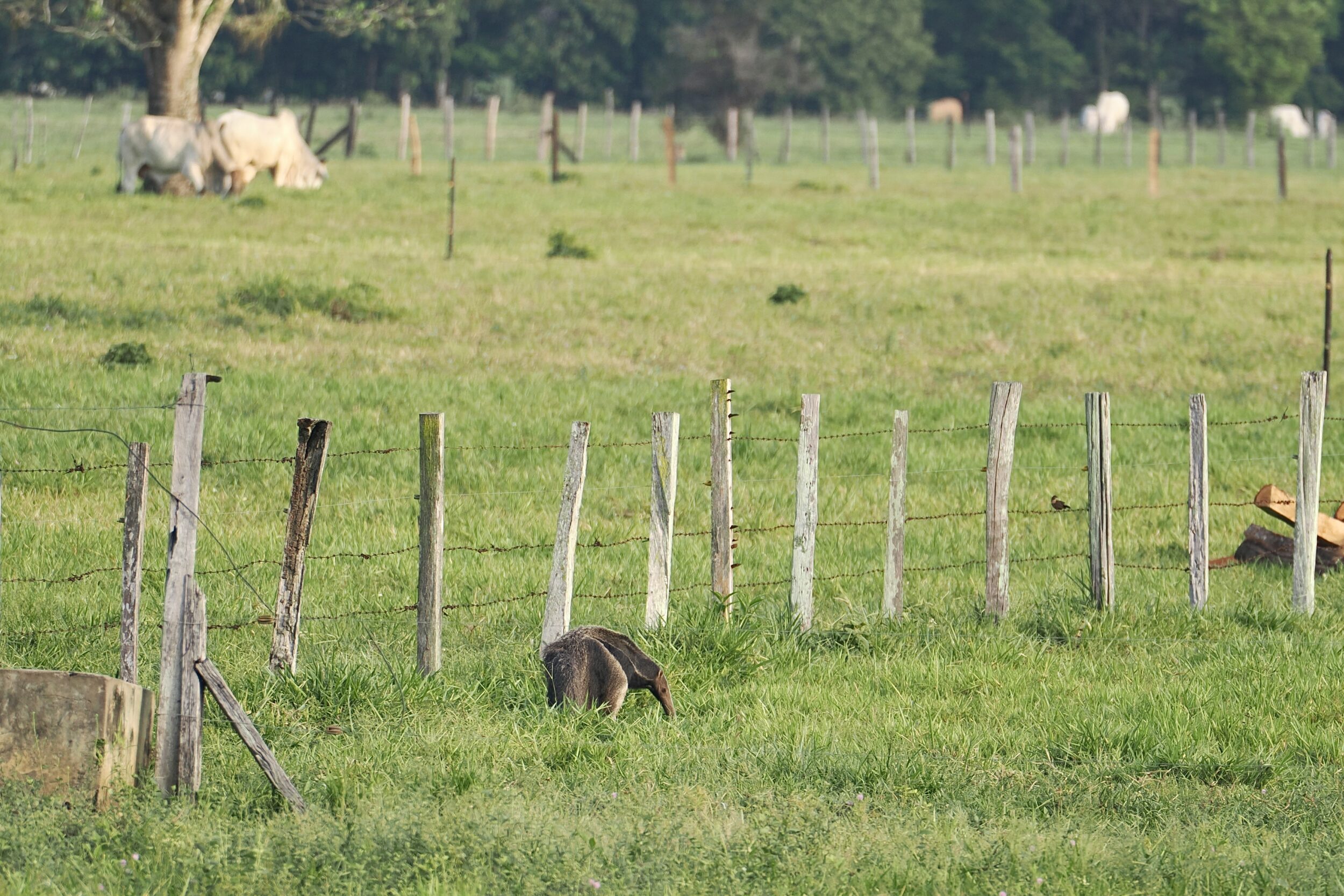
The pictured location’s altitude is very much lower (circa 450 metres ASL, rather than 3,500 metres) than was #5’s in this single-image series.
The climate here is very much hotter & the terrain is flat.
If it had been left in its natural state you would be looking at a photo of dense tropical rainforest, unfenced, with absolutely no cattle.
Assuredly, we are not the first visitors to be amazed that this “much-degraded” countryside is still inhabited by the largest of “our” globe’s four “anteater” species.
Myrmecophaga tridactyla – the giant anteater – can coexist with beef cattle…and it is not much-troubled by fences – non-electrified ones, at least.
This highly “adaptable” species survives in a wide range of climates & ecosystems, across a deal of South & Central America.
However, its conservation status is “vulnerable”; numbers are much-reduced & the species faces multiple threats to its existence.
Giant anteaters are very unusual in many ways – from their low body temperature, to their tongues’ prodigious length & strange “operating system”.
Their mouths contain no teeth.
Giant anteaters’ stomachs produce no “digestive” acids; there is a logical reason for this.
They prey – usually, exclusively – on ants & termites; a typical ant contains a whole lot of formic acid.
Eventually, a multi-image post will offer closer views & rather more information about these strange, charismatic beasts.