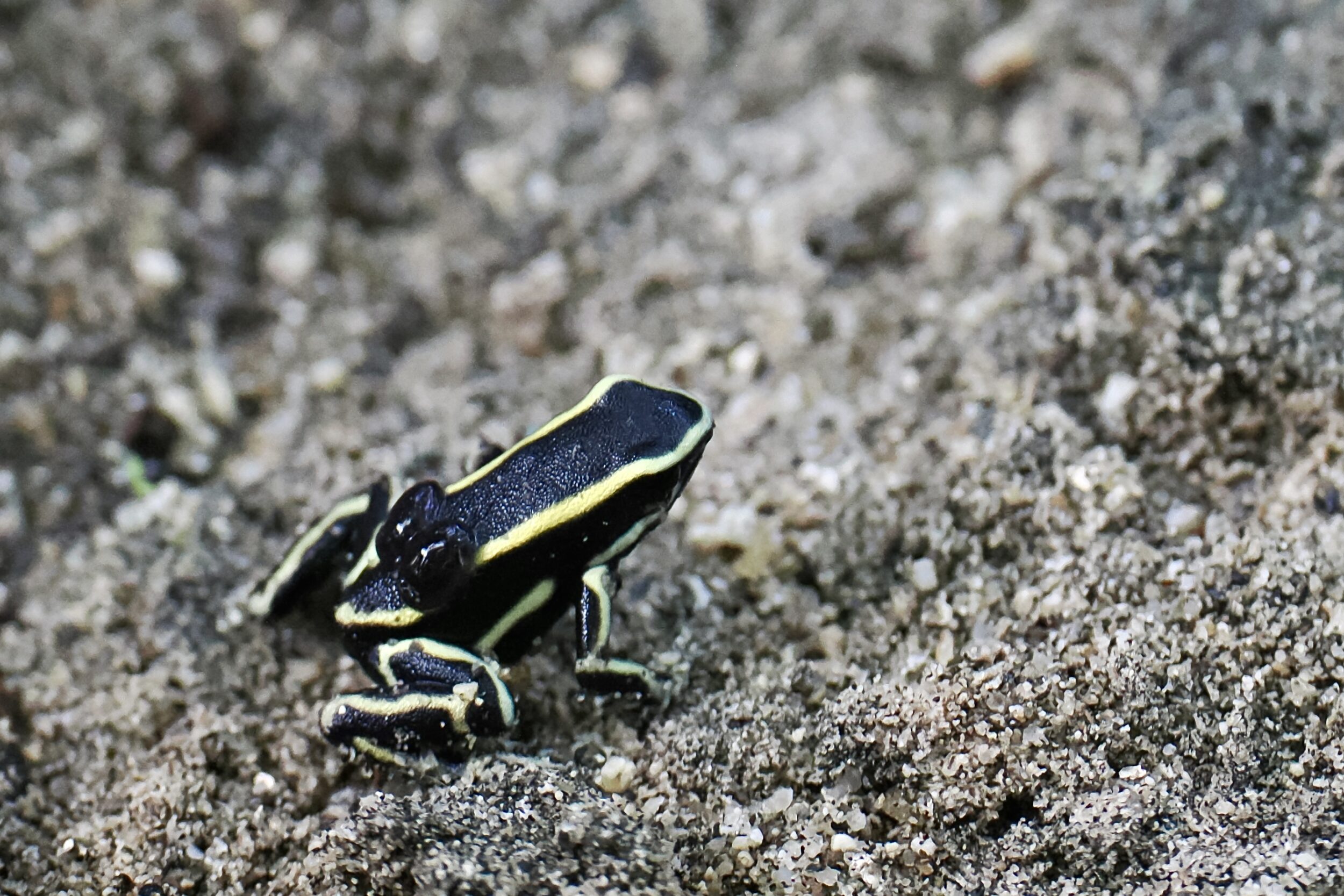
Q: why am I so very sure that this post’s hero is a male?
A: because he is carrying “the kids” on his back!
Adult poison dart frogs lay their eggs in moist places, including on leaves, in plants, among exposed roots, and elsewhere. Once the eggs hatch, the adult piggybacks the tadpoles, one at a time, to suitable water: either a pool, or the water gathered in the throat of bromeliads or other plants
(as you can see in my photo, the males sometime carry two tadpoles at one time)
The italicised quotation is from the (fascinating) Wikipedia entry on poison dart frogs; the toxicity is a by-product of their ant-rich diet.
It is generally reckoned that their “flamboyant” colouration is designed to deliver a “do not eat me” message to predators whose diet includes frogs.
Some of the least toxic poison frogs have the most flamboyant markings; presumably they are attempting to hoodwink the aforementioned frog-eaters!
Allegedly, the pictured species – Dendrobates truncatus – is endemic to northern Colombia’s lowland forests.
That is where we encountered the pictured individual, just a couple of kilometres in from the Caribbean shoreline.
I reckon this species is very probably also present on the other side of the nearby border with Venezuela; I suspect it may well also exist in Panama.
It is one of the less-common/less-widespread poison frogs, but this species is not currently considered “vulnerable” or “threatened”.
We counted ourselves very fortunate to see one, but it was obvious that our guide was not surprised by its visible presence.
Comments