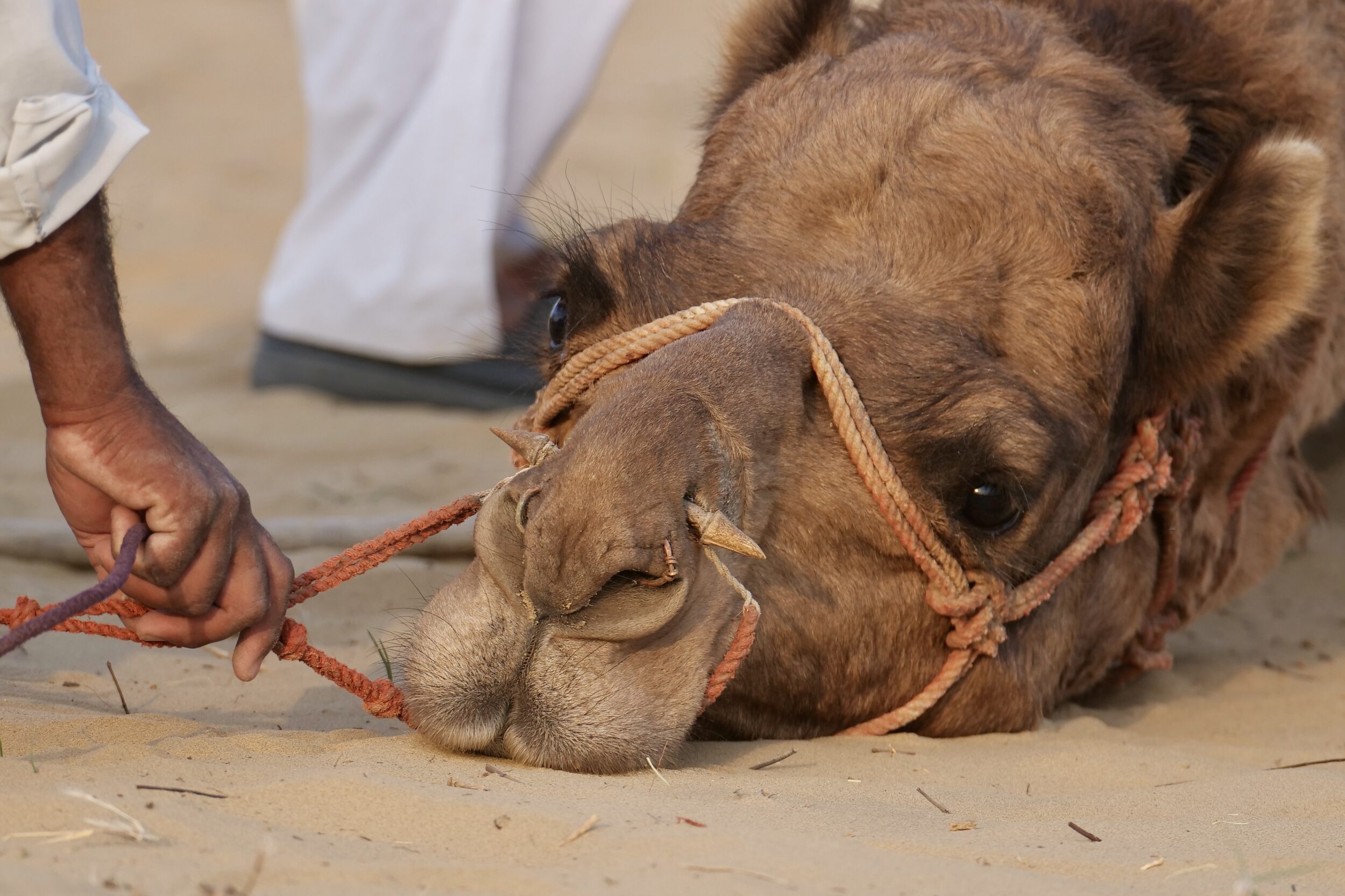
Globally, camel numbers are “exploding”, but India’s population is a small fraction of what it was half a century ago; it is still declining, rapidly.
India’s camels might be in the process of “disappearing”, along with a globally-unique and uncommonly-benevolent approach to camel husbandry.
Rajasthan – specifically, its part of the Thar Desert – has always accounted for most of India’s camels.
It is also home to most of the Raikas; for many generations they have revered, herded, trained, milked and bred camels. (and sheep).
Members of this indigenous tribe/cultural group abhor the very idea of killing or mistreating camels.
Inevitably, any well-travelled person has witnessed a deal of cruel or chillingly-indifferent treatment of “working” and/or “grazing” animals…camels included.
Accordingly, this (farm-raised) traveller was amazed and delighted to see how very well Rajasthan’s traditional camel-herders treated “their” camels.
Both of this post’s pictured (“riding”) camels were in good health, not stressed; it was obvious that they were accustomed to being treated kindly.
In this particular case, opting to ride a camel was not “dangerous”, and involved no “moral” unease – relevant camels and humans all appeared to enjoy the experience.
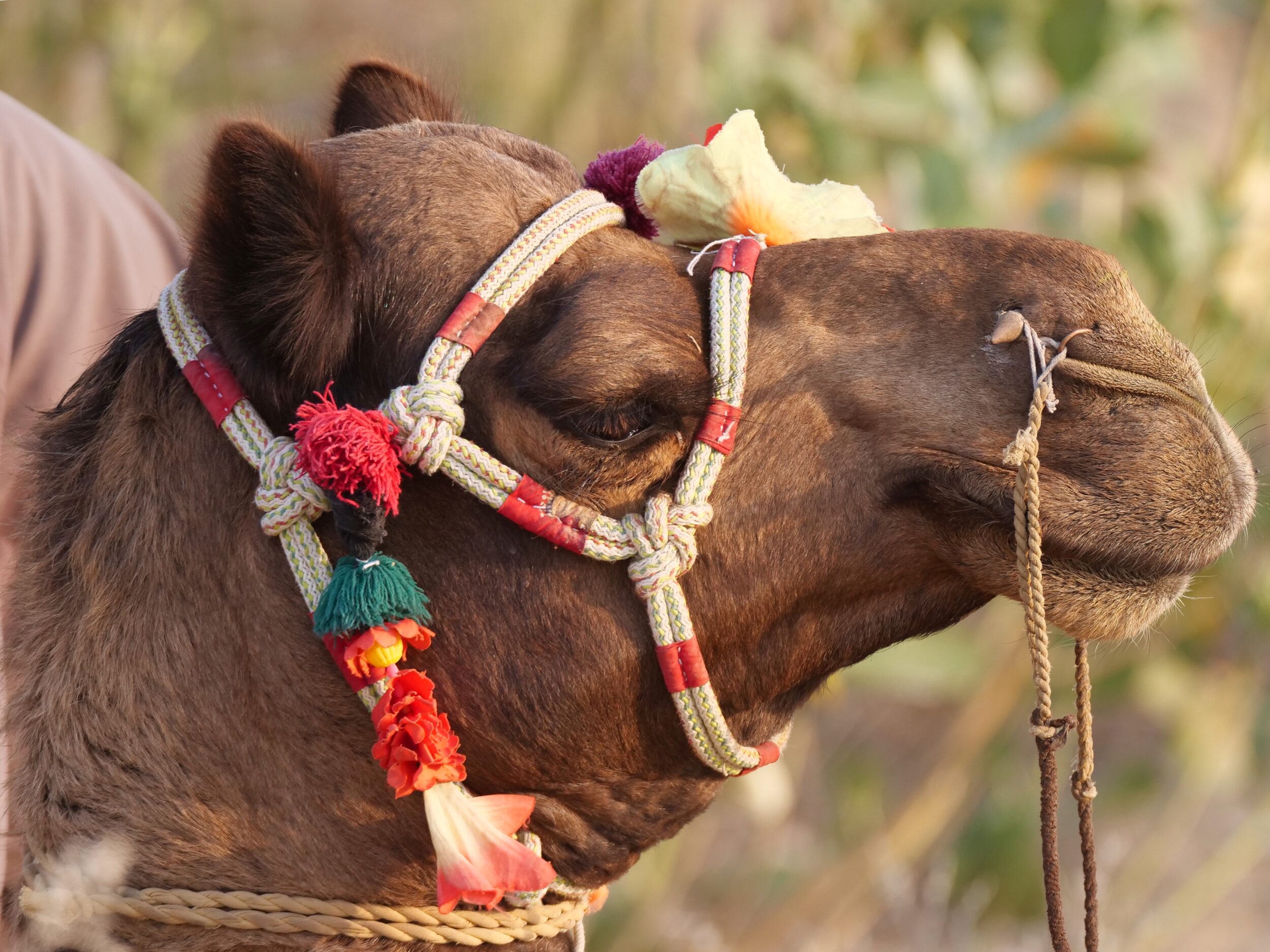
Still, “camel rides and photo-opportunities for tourists” can provide “full employment” for only modest numbers of Raikas and dromedaries.
Camels used to be the Thar Desert’s primary mode of transport.
Hugely-improved roads, motorised vehicles and rail have rendered-redundant the “ships of the desert”.
Dromedaries’ roles as providers of fuel (even when “fresh”, their dung is so dry that it burns readily) and food (traditionally, milk products only, not meat) and fibre has likewise diminished into insignificance.
Quasi-“nomadic” herders have increasingly been denied access to the lands on which their camels and sheep used to graze.
Global warming’s impact has also proved severe in Rajasthan.
Establishing a “slow food/gourmet/wellness”-oriented camel dairy industry was seen by some as a means of enabling the Raikas to maintain their traditions and earn liveable incomes.
Alas, the evidence to date suggests that “the numbers just do not add up” for commercial camel dairying in the Thar Desert.
Click here for an illustrated overview.
Footnote
The Thar Desert’s status as South Asia’s largest desert is a “very short story”, relative to most of the world’s large deserts.
Southern Africa’s Namib Desert – generally reckoned to be the oldest – has been a desert for at least 50 million years.
Much of the Thar only completed its rapid transition to desert status around 5 thousand years ago.
The process is much too complex to explain here.
Suffice that rising mountain ranges, shifting sands and rivers, and a period of global cooling which greatly increased the extent of “permanent” snow & ice all played key roles in “blocking” the monsoons’ ability to reach Rajasthan.
You can discover more in the ”Origin and Formation” section of the Thar Desert’s Wikipedia entry.
As a “not so long ago, much wetter” region, the Thar Desert has/had a lot of underground water.
Irrigation and India’s eager adoption of “The Green Revolution” have enabled Thar Desert agriculture to become astonishingly productive.
Famines – formerly, a recurring nightmare – have disappeared.
The sustainability of the “irrigation + Green Revolution” model is very open to question.
However, along with increasingly “unliveable” heat, the current round of climate change seems to have re-opened the monsoons’ access to Rajasthan.
From 2001 to 2023 the annual precipitation rate in the Thar Desert rose by 64 percent!
Click this for a scholarly examination of how and why this desert.is currently “greening”.
Comments