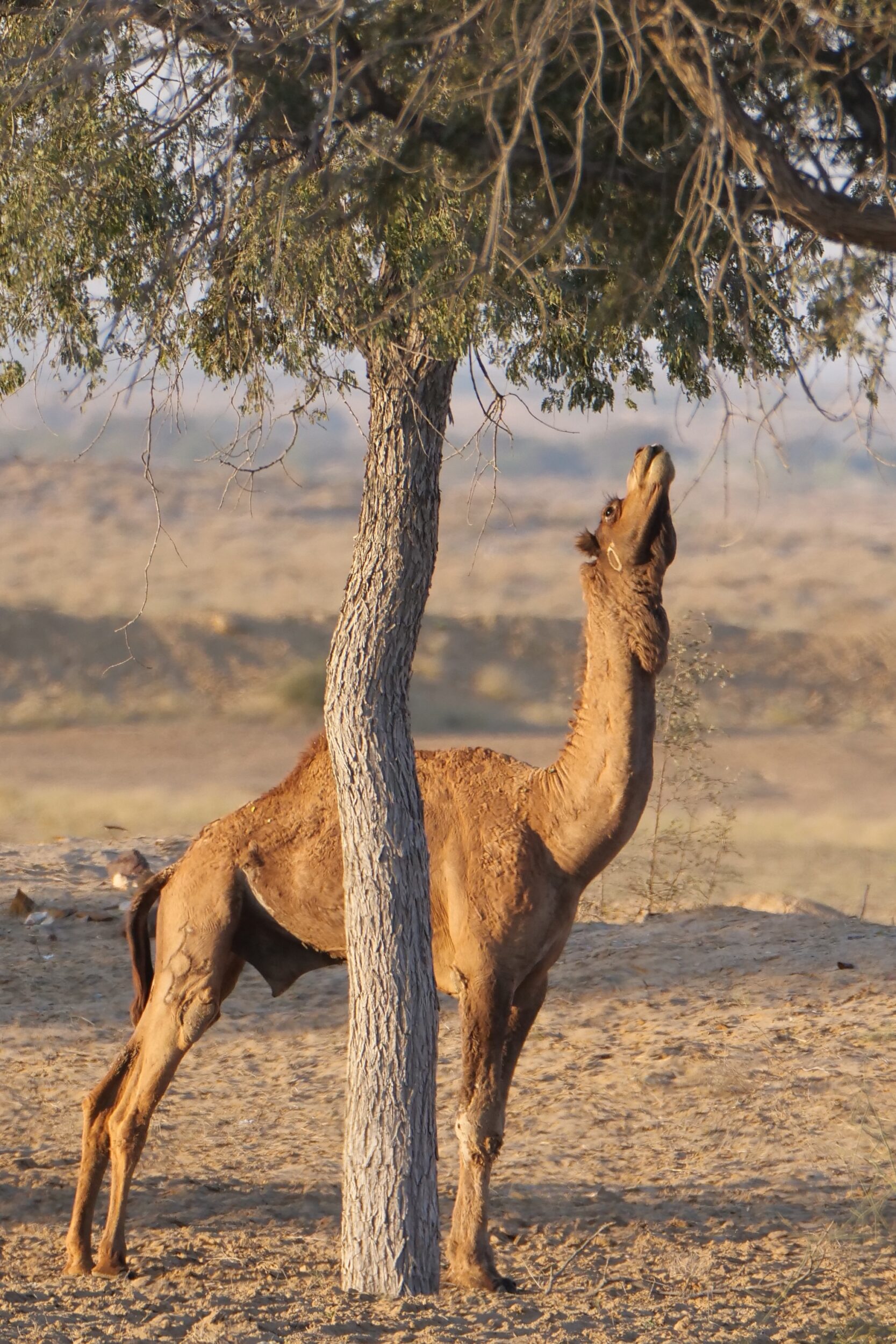
So many things which are oft-said about camels – and widely-believed – are simply untrue.
“Australia has the world’s largest camel population” is a ludicrous assertion; many other countries have many more camels.
However, another oft-made claim – that more camels now live in Australia than in Egypt – probably is true.
Australia almost certainly has the largest population of feral camels…all of the same species as the individual pictured above, in Rajasthan – Camelus dromedarius, the dromedary.
It is sometimes (wrongly) called “the Arabian camel”.
Currently, more than 90% of “our” planet’s camels are dromedaries.
More than 95% of all living camels are domesticated, “working” animals; this was also true of all “first generation” Australian-resident camels, who arrived from the mid-19th through to the early-20th century.
Camels store fat in their humps, not water.
The “original” camel species was a rabbit-sized North American!
Ancestrally-speaking, literally all members of the three living camel species are the descendants of North Americans…in the same sense that humans “began” in Africa.
Also contrary to popular misconception: the first horses were fellow-North Americans, some of whose descendants also eventually crossed into Eurasia.
Eurasia’s and Africa’s camels are descended from those who traversed the former “land bridge” over the Bering strait, from North America, circa 6 million years ago.
The “disappearance” of North America’s camels (and its original horses) was likely a consequence of the arrival of that continent’s first humans, who also crossed the Bering Strait, but in the opposite direction – from Eurasia.
Click here to discover many more (oft-surprising) things about camels; click this for an overview of the whole camelid family, which also includes camels’ South American relatives/descendants.
There is no definitive answer to the question, “when did humans first domesticate camels?”, but it was almost certainly less than five thousand years ago; it could be not much more than three thousand years.
Counting camels is an even more formidable challenge than counting sheep, but it is safe to say that camels’ global population is currently rising, rapidly.
World Population Review estimates the current figure at more than 40 million.
Chad has the largest national population; it is home to circa 25% of the world’s living camels.
All “top four camel nations” are African; even fourth-ranked Kenya has more than twice as many camels as fifth-ranked Saudi Arabia.
Cow-centric India is well down the list. Most of its fewer than 200,000 camels are in Rajasthan.
The Thar Desert’s camels have long been important, both economically and culturally.
This series’ next chapter stars two well-loved camels.
It will also offer some explanation of how and why the Thar has become such an “exceptional” desert…& why its camel population has dramatically/catastrophically declined, whilst camels’ global numbers have exploded.
Comments