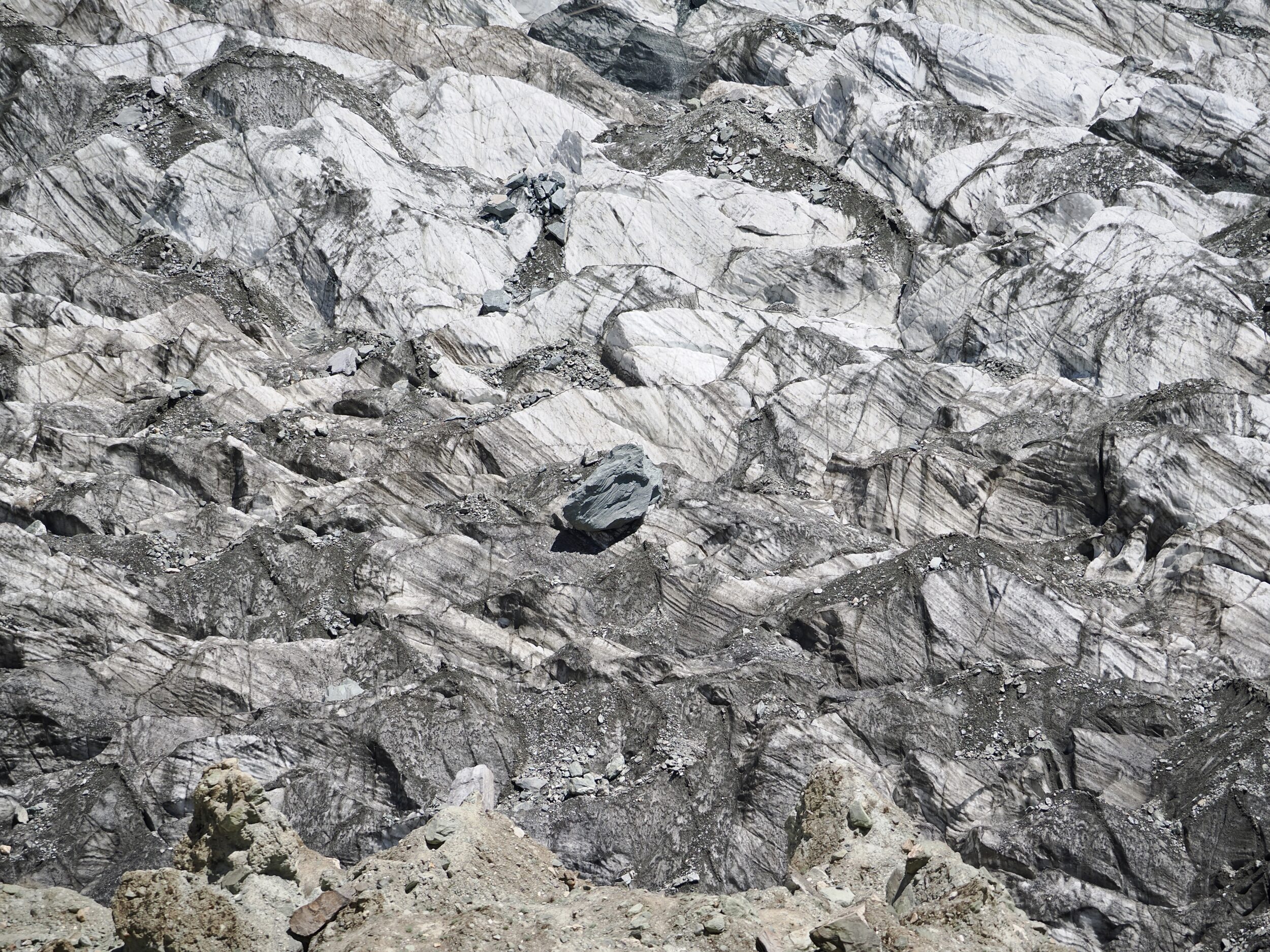
The featured image was not shot in monochrome.
Its colour palette is accurate; if my camera had looked straight up rather than almost straight down, the image would have largely been blue, flecked with white and grey.
I took the photo in a “remote” part of northern Pakistan’s Gilgit-Baltistan province in May 2024.
What appears to be a rock is a rock; I have no idea of its mass, but am sure it would weigh at least several tonnes.
In the context of the relevant valley, however, that rock is a speck!
Uphill from my photo’s vantage point, a lookout enables one to look upstream, up-up-up to towering peaks and the “properly white” snow which feeds this famously-dark glacier.
Its name is most commonly rendered as “Hopar” or “Hoper” or “Hopper” Glacier, although some sources call it by an unrelated name and/or regard it as merely a “tongue” of another huge glacier.
As tends to be true in the Karakoram, written sources offer wildly-varying statistics.
Two mutually-contradictory figures oft co-exist within the very same article – as is the case here, but clicking the link will give you a sense of just how extraordinary (and extreme) is this part of the world.
Perhaps my photo’s “hero” rock had thundered down onto the lower part of the glacier’s surface recently, via a landslip from the heights above, probably with an earthquake’s assistance.
Or had the glacier collected or directly gouged it from somewhere kilometres distant and thousands of metres higher, who knows how long ago, before covering it, then transporting the rock for who knows how far, over who knows how many years?
If that were the case, and the near-surface ice melted, progressively, as the “river of ice”proceeded downhill, the rock would eventually become visible, sitting atop the glacier
The Hopar/Hoper/Hopper is one of the world’s fastest-moving glaciers; it could be the fastest.
Let us assume that a commonly-quoted estimate of its speed is correct-ish, and that the pictured rock had been transported 10 kilometres in order to reach its pictured position.
This super-fleet glacier would have required more than 200 years to achieve that feat!