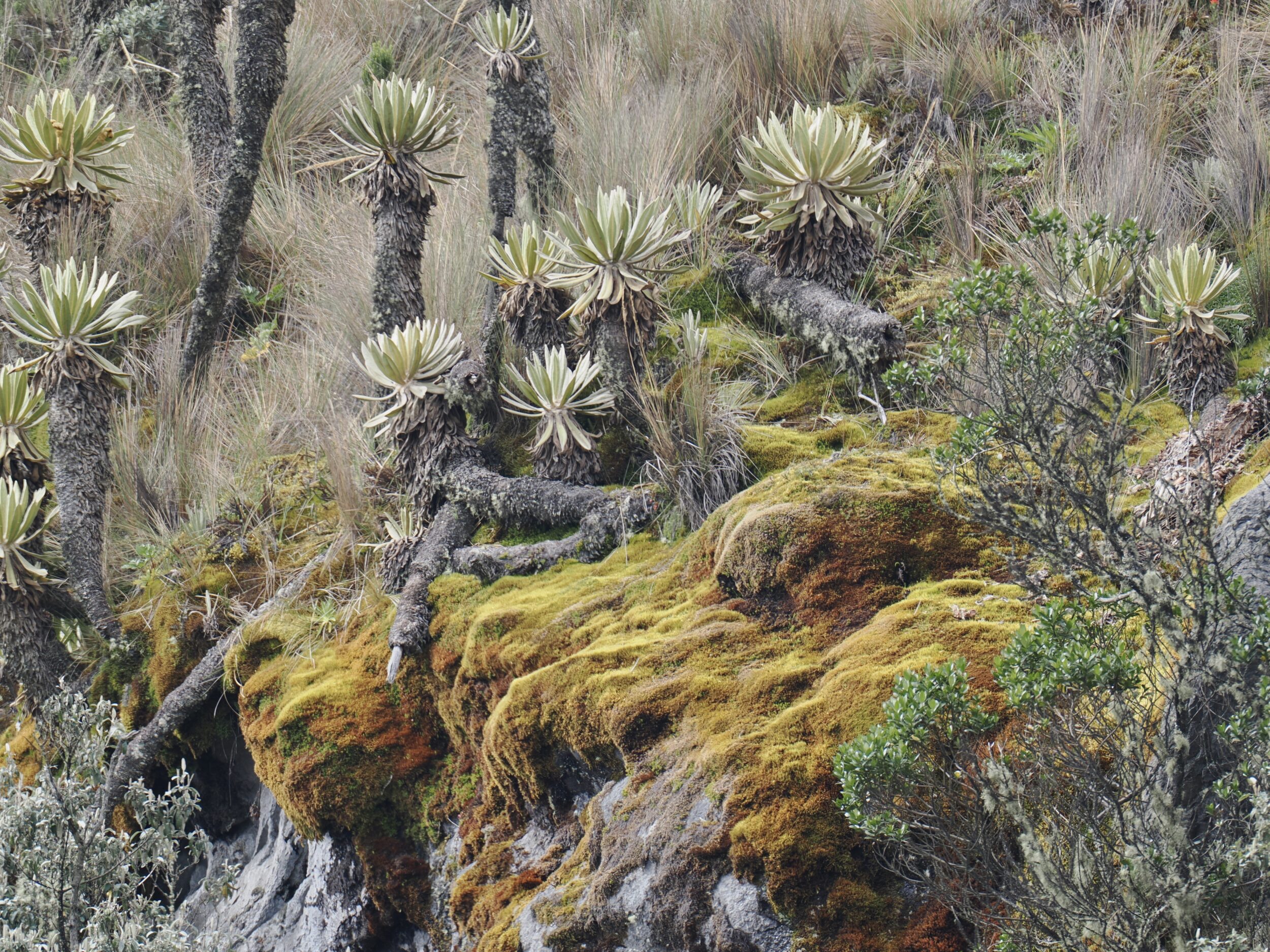
Members of the genus Espeletia are the signature plants of páramo – a wondrous-strange “tropical tundra” ecosystem which exists only in certain very high, very wet parts of northern South America & southern Central America.
Much páramo has been destroyed (or much-degraded) by humans & their livestock; climate change is another existential threat.
More than half of the surviving páramo is in Colombia.
Espeletia species are generally known as frailejones, which translates into English as “big monks”.
To Australian eyes, they look a bit like our so-called “grass trees”, but they are not even remotely-close relatives.
Espeltia, Xanthorrhoea & Kingia genus members do, however, share one reality: all are neither grasses nor trees.
The frailejones’ actual “cousins” are sunflowers!
I took the photo on the morning of 04 March this year, at an altitude of circa 4,000 metres ASL, on the flanks of Nevado del Ruiz volcano.
Páramo is crucial to the fresh water supply in countries like Colombia; this is in large part thanks to the frailejones’ prodigious ability to “harvest” water vapor – not just rain – from passing clouds.
Frailejones collect water in their spongy trunks, then deliver much of it – via their roots – to the soil below.
Páramo functions as an enormous, slow-release “sponge” – one which feeds rivers & lakes.
Eventually, a Pelican Yoga series of multi-image posts will show & tell much more about the páramo; it is one of the most “jaw-dropping” environments on earth.
If you wish to know and see a little more right now, click here.