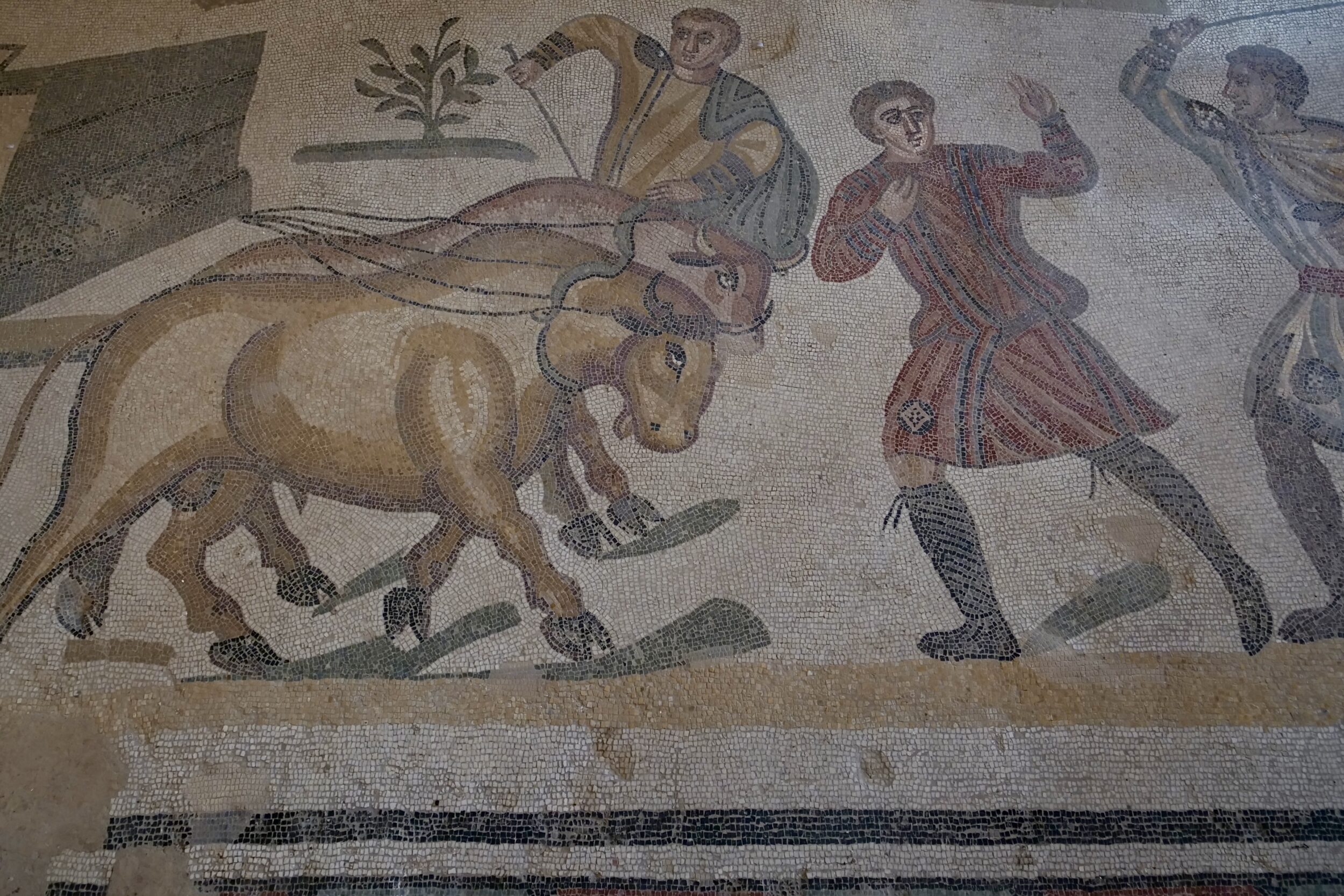
Generally – but not in this series – Pelican Yoga inclines to so-called “wild” environments and animals…to what we like to call the “natural” world.
“Wild” and “natural” are highly problematic/contestable terms.
So too are their alleged opposites: so-called “domestic or “domesticated” animals and “unnatural” or “degraded” environments.
This series features animals which humans have “domesticated”, “tamed”, “farmed”; some of them we put to work, whilst others become our pets, companions, or furry/feathered “friends”.
We selectively breed, train, confine them…in order to satisfy human yearnings, fads, fashions, and notions of what is “beautiful”, “impressive” or “cute”…or to maximise meat production for human consumption.
This series’ opening image shows part of a Roman mosaic.
Circa 1,600 years old, it was created when the global biomass of “wild” mammals still hugely exceeded that of humans and their “domesticated” mammals.
A pertinent question:
What are the relevant proportions, now?
Humans and livestock make up 95% of the world’s mammal biomass; wild mammals are just 5%. (according to Our World in Data)
Click here for the full article, which includes several graphs.
Humans alone greatly exceed the estimated biomass of all wild mammals.
We now account for more than one third (around 36%) of the total mammalian biomass.
Our cattle make up a slightly larger portion, estimated at 38%.
The biomass of “our” horses and dogs – a combined total of circa 5% – is roughly equivalent to that of all remaining wild mammals.
Our poultry hugely outweigh “our” planet’s remaining wild birds; the former comprises circa 71% of all “feathered friends” biomass.
I took this post’s photo on 27 September 2023, at the world’s key destination for lovers of Roman mosaics – Sicily’s Villa Romana del Casale.
Comments